Since October 30, Under the Hood lists the posts that got a label, not just how many. The first thing a lot of people want to do is delete those posts and hope the report and their reach come back. I read the code that builds the report and the code that adds the labels. Deleting doesn't do what you'd hope.
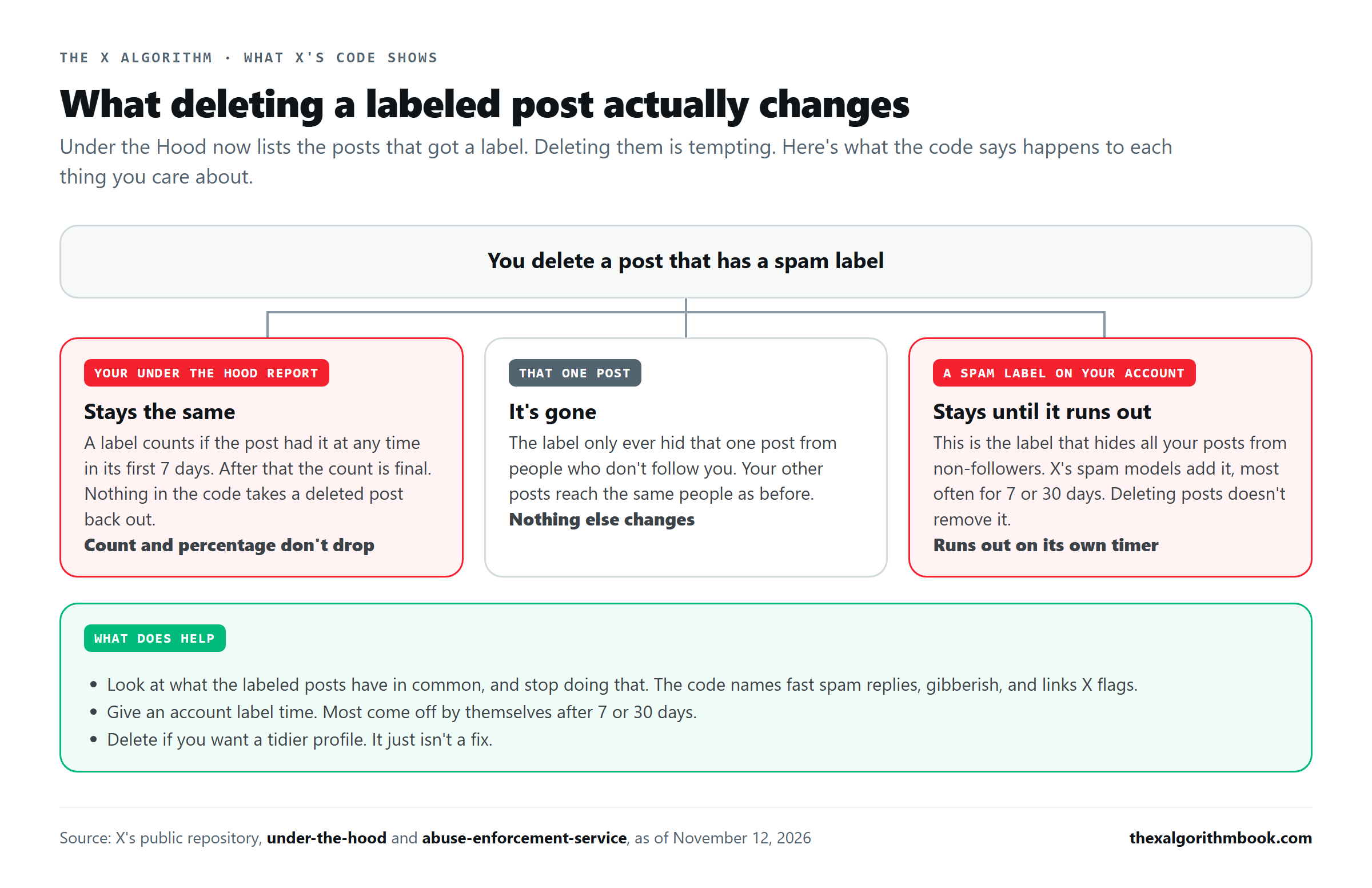
Does deleting a labeled post lower the count in your report?
No. Under the Hood is a monthly report about something that already happened. For each post, X's code checks whether a label was put on it at any point in the 7 days after you posted it. If it was, the post counts as carrying that label for the month. Once those 7 days pass, the count for that day is final.
Nothing in the Under the Hood code checks whether a post was later deleted, and nothing takes a counted post back out. Your percentage is the number of labeled posts divided by all the posts you made that month, so it doesn't drop either.
What does this look like on a real account?
Here's mine. My Under the Hood report for October covers 6,985 posts. One of them got SPAM_HIGH_RECALL: 1 of 6,985, or 0.01%. There were no account labels. This is the post:
The report doesn't say why the spam model flagged it, and neither does the code. If I deleted it today, my October report would still show 1 of 6,985, because the post had the label during its first 7 days. And since the label sat on the post and not on my account, it only kept this one post out of recommendations to people who don't follow me. Nothing else I posted that month was affected by it.
What does the "removed" number in the report mean?
It counts labels that came off during those first 7 days, either because X removed them or because they expired. It doesn't count posts you deleted.
Does deleting the post help your reach?
Only for that one post, and only in the sense that the post is gone. A spam label on a post affects that post and nothing else. SPAM_HIGH_RECALL, the most common one, hides the post from people who don't follow you. Your followers can still see it, and your other posts reach the same people they did before.
Some post labels also end on their own. In X's enforcement code, the spam label added to posts rated as gibberish or as fast spam replies lasts 30 days.
Which label actually hurts your reach?
The spam label on your account. When your account carries SpamHighRecall, every post you make is hidden from people who don't follow you, for as long as the label lasts. Under the Hood lists account labels separately from post labels.
X's spam models add the account label, and most of the rules in the code give it an end date. Some last 7 days and some last 30 days, and some of them also ask you to prove you're a real person. Deleting posts doesn't remove it. It comes off when its time runs out.
What the models look at to decide your account is spammy isn't in the public code. So I can't tell you that deleting old posts lowers your chances of getting the label again, and I can't tell you it raises them.
Can you appeal a label from Under the Hood?
Not yet. The code has appeal instructions for each label, but the setting that shows them in the report is switched off.
Who gets a report at all?
Your account has to be at least a year old, and you have to have made at least 10 posts in the month. Suspended accounts don't get one.
So what should you do?
- Look for the pattern. Open the posts Under the Hood lists and look at what they have in common. X's enforcement code names fast spam replies, gibberish and links it flags as causes of the post spam label.
- Stop doing that thing. It's the only step that affects future months.
- Give an account label time. Most come off by themselves after 7 or 30 days.
- Delete if you want a cleaner profile. That's a fine reason. Just don't expect the report or your reach to change because of it.
The code is in X's repository under under-the-hood and abuse-enforcement-service. I covered the post list itself in Under the Hood now shows which posts got a label.
Source: X's published code, commit cec6168.
What to do about it is in the book. Updates say what changed. The book explains how the feed works and what to do, and it's revised every month from X's code.
See what it costs