Every question, answered.
How X's feed works, what limits a post, how to write and grow, how the rewards program works, and how this book and your account work. 314 answers, searchable, with the numbers read live from X's published code. Looking for the calculators and checkers? They're all on the Tools page.
314 answers in 29 sections
About the book
What the book covers, who it's for, and where to begin.
What is The X Algorithm?
It's a handbook that explains five things: how a post on X reaches people, what can stop it from reaching them, how that reach turns into numbers, how those numbers get you into X's Original Content Rewards Program, and how to run an account so it gets there.
It's rebuilt every month from X's published code, X's written rules, and fresh numbers from live accounts. What is included lists every part of it.
- Part OneHow to use this bookThe short version, the account types, the one idea
- Part TwoHow the feed worksThe seven steps, the weights, the four adjustments
- Part ThreeWhat can limit youThe visibility rules, every label, how labels get applied
- Part FourThe numbersX Analytics, the Under the Hood report, the API
- Part FiveThe rewards programEvery rule, and the legal terms
- Part SixWriting postsWhat the data says works, questions, statements, replies, timing
- Part SevenGrowing followersWhere follows come from, the follow-back rule
- Part EightPosting toolsWhat the rules allow, and what a tool must never do
- Part NineEvery advantageAll fifteen in one list
- Part TenThe road to the programThe plan, in phases, with dates
- Part ElevenMonthly operationsThe checklist, step by step
- Part TwelveWhen something breaksReach drops, labels, locks, denials
Who is it for?
Anyone who posts on X and wants to understand why some posts travel and others don't: individuals, small businesses, writers, and anyone working toward the Original Content Rewards Program.
It's written for people who have never read a line of code. If you'd rather be told a trick than shown how the system works, this isn't that book.
Do I need to know how to code?
No. Every term is defined the first time it's used, there's a glossary at the back, and every number says where it came from. Boxes marked Technical Stuff show where a fact was found in X's code, and they can be skipped.
What is the whole book in one sentence?
Write posts people want to answer, and don't behave like a machine. Everything else is scheduling.
What is the one idea the book depends on?
X doesn't show your post to your followers. X shows your post to whoever it predicts will do something with it. Your followers are the people most likely to be in the pile, and strangers get in too, when X thinks they'll respond.
So the question is never "how do I reach my followers." It's "what does X expect a person to do with this post, and how do I make that a reply."
Reach is decided one viewer at a time. There is no single reach number a post is given. There are millions of small predictions, and the post wins or loses each one.
How is this different from other advice about X?
Every rule comes from one of four places, and the book says which one:
- X's own published code, all of it.
- X's published rules, program terms, and help pages.
- X's monthly Under the Hood enforcement reports.
- Live accounts, every post measured post by post through the X API.
Most numbers are facts read straight from X's code or analytics. The few that are estimates are labeled as estimates. Every rule carries the date it was read, because X changes them, and where X has kept part of its code private the book says so instead of guessing.
Where do the numbers come from?
Four places: X's published feed code; X's written rules, program terms, and help pages; X's monthly Under the Hood reports; and live accounts measured through the X API. The numbers shows the current values from X's code with the arithmetic.
I only have ten minutes. Where do I start?
Read Chapter 2, "The short version, how to post." It's the whole book in five pages, with a table of what every action is worth, a Do list, a Don't list, and what to do after you post. Each line points to the chapter that explains it in full.
What will I be able to do after reading it?
- Explain why a post did or didn't reach people.
- Write posts that earn replies, and replies that earn followers.
- Read your analytics and your monthly Under the Hood report.
- Tell which behaviors X's spam systems look for, and avoid them.
- Work out exactly where you stand against the Original Content Rewards Program requirements, and what to do each month to get there.
Can I read some of it before I buy?
Yes. The sample opens the same reader with the front of the book, all of Chapter 1, and the start of Chapter 2. The highlights, notes, and bookmarks all work in it.
Is it affiliated with X?
No. It isn't made, endorsed, sponsored, or reviewed by X Corp. X's code is quoted from X's public repository under its open-source license.
Who wrote it?
Bill G. Wolcott. The About page in the book says the rest.
How the feed works
The seven steps X runs every time someone opens the For You feed.
Is X's algorithm open source?
Yes. X publishes the code behind its For You feed in a public repository, github.com/xai-org/x-algorithm: the ranking weights, the filters, and the labeling rules. This site reads all of it. The current values are on The numbers, read on November 19, 2026, commit b551517.
X keeps a small set of files private on purpose: the instructions its spam and safety classifiers use, and some rules its spam engine runs. The book says where that is the case instead of guessing.
How does X decide what to show me?
Every time someone opens the feed, seven things happen in order. Select a step to read what it does.
X loads what it knows about the person who opened the app: their recent actions, who they follow, who they have blocked and muted, the words they have muted, the posts they have already seen, and the topics they follow. Everything after this is measured against that one person.
Posts are collected from four places at once. Thunder holds the last 48 hours of posts and hands over recent posts from the accounts the viewer follows. Phoenix retrieval finds posts like the ones the viewer has engaged with. SimClusters pulls posts from the communities the viewer belongs to, out of about 145,000. A shared list of popular recent posts was added in October 2026.
Each post is loaded with what X needs to judge it: the text and any image, the author and any labels on the account, the quoted post, the language, how much engagement the post has so far, and whether it is for subscribers only.
Before anything is scored, X removes what can't or shouldn't be shown: duplicates, posts older than 48 hours, the viewer's own posts, posts from blocked or muted accounts, posts with muted words, posts already seen, and more. The filters run in a fixed order.
A model called Phoenix estimates, for this viewer and this post, how likely each of about twenty actions is: like, reply, repost, quote, three kinds of share, click, profile click, open a link, expand a photo, open a video, stop and read, follow, and the four negatives: not interested, mute, block, report.
Each predicted chance is multiplied by that action's weight and the results are added into one score for this post and this viewer. Four adjustments follow: author diversity, the out-of-network discount, the new-author lift, and a reordering pass.
The 50 highest scores are picked. A separate visibility system then checks each one against the labels and rules and removes any post the viewer isn't allowed to see. The top 35 go into the feed, with ads and "Who to follow" boxes placed between them.
Does X show my post to all my followers?
No. X predicts, for each person, how likely they are to do something with the post, and shows it to the people with the highest predicted response. Followers are the most likely to be in the pile of candidates, but they aren't guaranteed to be shown the post.
What are Thunder, Phoenix and SimClusters?
They're X's names for three of the systems in the pipeline:
- Thunder keeps the last 48 hours of posts and hands over recent posts from accounts the viewer follows. These are in-network posts.
- Phoenix is the prediction model. It estimates the chance of each action for each viewer and post. It also finds out-of-network posts similar to ones the viewer engaged with.
- SimClusters sorts every account into about 145,000 communities based on who engages with whom, and pulls posts from the communities the viewer belongs to.
Phoenix retrieval and SimClusters are how a stranger sees you. They're why it matters who you engage with: your community is defined by who engages with you and who you engage with.
- Accounts you followThunderRecent posts from accounts the viewer follows, kept for 48 hours
- Accounts you don't followPhoenix retrievalPosts like the ones the viewer has engaged with
- Accounts you don't followSimClustersPosts from the viewer's communities, out of about 145,000
- Accounts you don't followPopular-posts listA shared list of popular recent posts, added in October 2026
How many posts does X score, and how many reach my screen?
The 50 highest-scoring posts are picked. A separate visibility check removes any the viewer isn't allowed to see, and the top 35 go into the feed. Ads and "Who to follow" boxes are placed at fixed spots between them, so 35 isn't 35 organic posts set aside for anyone.
- GatherRecent posts from followed accounts, posts like ones the viewer engaged with, posts from their communities, and the popular-posts list
- FilterDuplicates, posts over 48 hours old, the viewer's own posts, blocked and muted accounts, muted words and posts already seen are removed
- ScoreEvery post left gets a predicted chance for each action, times its weight, plus the four adjustments
- Pick 50The 50 highest scores go forward
- Visibility checkAny post the viewer isn't allowed to see is removed
- 35 in the feedWith ads and "Who to follow" boxes placed between them
How long can a post be shown in the feed?
Forty-eight hours. After that it isn't pulled into the Home feed again.
First 2 hours. The only window in which the new-author lift can choose the post.
Up to 48 hours. The post can be pulled into the Home feed.
After 48 hours. Gone from the feed for good. Still on your profile, in search, by direct link, and in a conversation someone opens.
It isn't gone from X. It's still on your profile, in search, through a direct link, and in a conversation somebody opens. To use an idea in the feed again, post it again later in different words. Different words is a requirement, not a suggestion: word-for-word reposts get labeled.
What does X predict about each post?
For about twenty actions, how likely this viewer is to take each one.
- Positive: like, reply, repost, quote, three kinds of share, click into the post, click the profile, open a link, expand a photo, open a video, stop and read, follow the author.
- Negative: tap "not interested," mute the author, block the author, report the post.
The published training code shows what the model looks at: who wrote the post, a code that describes what it's about, the time of day where the viewer is, which tab they're on, how old the post is, what the viewer did recently and how long they spent on each post, and a profile of the viewer. The engagement a post has already earned feeds the guess for the next viewer, which is why the first hour of a post's life matters.
Engage
- Like+0.708
- Reply+5
- Repost+1
- Quote+5
Share
- Copy the link+20
- Send by direct message+5
- Share button+2.118
Look closer
- Click into the post+0.274
- Click the profile0
- Open a link+0.2
- Expand a photo+0.05
- Open a video0
- Stop and read+0.05
Follow
- Follow the author+4
Push away
- Not interested-53.07
- Mute the author-58.8
- Block the author-31.2
- Report the post-234
How is a post turned into a score?
Each predicted chance is multiplied by that action's weight, and the results are added into one score for that post and that viewer. The weights section has the full table and a calculator.
What changes the score after that?
Four adjustments are applied on top of the weighted sum:
- Author diversity multiplies down each of your posts after the first in one reader's pile.
- The out-of-network discount scores posts from accounts the viewer doesn't follow at 0.75.
- The new-author lift raises one eligible post from a small account.
- A reordering pass pushes near-identical posts apart so the list stays varied.
Each has its own question below.
What is the author diversity rule?
When more than one of your posts is in the pile being scored for one viewer, each one after the first is multiplied down. This is why posting a lot doesn't flood any single person, and why spreading posts across the day works: different people open the app in different hours.
- First post of yoursx 1
- Second post of yoursx 0.625
- Third post of yoursx 0.4375
- Fourth post of yoursx 0.34375
- Fifth post of yoursx 0.296875
- Sixth post of yoursx 0.2734375
The count is over your posts inside that one scored pool, not the posts you published in an hour.
Why are posts from accounts I don't follow scored lower?
A post from an account the viewer doesn't follow is scored at 0.75. So are replies and reposts, even from accounts they do follow. A reply you write starts at a disadvantage, and it still does well when it lands in a conversation the viewer already cares about.
Does X help new and small accounts?
Yes, for a short window. This is the one place the code deliberately helps small accounts. Every time a feed is built, X looks for posts that pass six tests, then lifts one of them.
- The post is an original post, not a reply or a repost
- The author has 50,000 followers or fewer
- The post is 2 hours old or less
- The post has fewer than 200 Home impressions so far
- The post ranks in the top 97 percent of the scored posts. You can't see this test
- For viewers in X's experiment on the lift, the author's account is in the same test group as the viewer. You can't see this test either
Fill it in, then buy the book to see your answer here. You also get the online reader, your own EPUB, the Post lab and twelve months of monthly drops.
X picks the eligible posts that collect likes quickly for their views, with some chance mixed in, using a method called Thompson sampling. The lifted post's score is raised to at least the score of the post at position 15 or 16 in that viewer's pile.
Three limits: the lift only works on posts that were already retrieved and scored, a place in the pile isn't a promised place on the screen, and the code doesn't say how many viewers are in each test group. It gives a small account a chance it wouldn't otherwise get, not a reserved slot.
The window is short: first two hours and first 200 impressions. Send your best questions when your readers are awake, because the first people who see a post matter most.
What is the reordering pass?
After scoring, a separate service reorders the top of the list so posts next to each other aren't too similar. It will accept a slightly lower score to avoid showing two posts that say nearly the same thing back to back. The practical effect for you: two of your posts that say the same thing, in the same viewer's pile, compete with each other, and one of them loses.
What is the popular-posts list?
A shared list of up to 500 recent posts, the same for every viewer, built by a background job. It takes accounts that posted in the last seven days, keeps the most-followed 1 in 20,000, collects their posts from the last 24 hours, and ranks them by views adjusted for age, with at most five posts per account. It has been on by default since October 7, 2026.
For nearly every account it's competition for the feed's slots, not a source of reach, because the accounts on it are among the largest on X.
Do experiments change the numbers?
Sometimes. X says it constantly runs experiments on a small share of feed traffic, and aims to publish any experiment running on 10 percent or more. Many values are read from a live configuration system, and X runs scripts that copy production values back into the public code as defaults. The numbers here are the production defaults on the day they were read, and a given viewer may be in a test bucket that differs.
How often does X change its algorithm?
What is the code actually called, and where is it?
It's the x-algorithm repository at github.com/xai-org/x-algorithm. The request path is the home-mixer directory. The in-network store is thunder, the model is phoenix, and the visibility rules are in visibility-filtering. The current commit the book was read against is on The numbers.
What each action is worth
The weights X multiplies by its predictions, with the arithmetic.
What is a weight?
A weight is a number that says how much X values an action. Before showing your post to a person, X predicts how likely that person is to take each action. It multiplies each prediction by the action's weight and adds the results into the score that sets the post's position in that person's feed.
A weight is not points a post wins or loses after something happens. It's a multiplier on a prediction, applied before the post is shown. Try it:
| Action | Chance | Weight | Adds |
|---|---|---|---|
| Weighted sum for this viewer | 0 | ||
The first position is a worked example: a 30 percent chance of a like, a 4 percent chance of a reply and a 0.1 percent chance of a report add up to +0.1784 with X's current weights.
How much is a like worth?
A like has a weight of 0.708. It's the base unit: every other weight in the book is compared against it, and a like is the lowest-value positive action.
How much is a reply worth?
A reply weighs 5, which is 7.0621 times a like. That means the predicted chance of a reply pulls 7.0621 times harder on the score than the predicted chance of a like. It doesn't mean one reply equals 7.0621 likes, and almost everyone writing about these numbers gets that wrong.
Is one reply worth ten likes?
No. X added a comment to its scoring code in August 2026 saying so directly: reading these ratios as count equivalences, such as "one report cancels 468 likes," is incorrect, because the weights apply to predicted probabilities and not to raw counts. The right-hand column on The numbers is a ratio between two weights, not a number of likes.
What are all the weights, side by side?
Predicted actions that raise a post's score
- Reply to an original post when you and the reader follow each other20
- Share by copying the link20
- Reply5
- Quote5
- Share by direct message5
- Follow the author from the post4
- Share button2.118
- Repost1
- Like0.708
- Click into the post0.274
- Open a link0.2
- Open a video0
- Expand a photo0.05
- Stop scrolling and read0.05
- Click the profile0
Predicted actions that lower it (own scale)
- Report the post-234
- Mute the author-58.8
- Tap "not interested"-53.07
- Block the author-31.2
What is a quote or a repost worth?
A quote weighs 5, the same as a reply, and it comes with an audience of its own. A repost weighs 1, 1.4124 times a like.
What is a follow worth?
Following the author weighs 4, 5.6497 times a like, and it happens on the post: the viewer sees a post and taps the name or follow button right there. A click on the profile is weighted zero, but the profile is still where most people decide whether to follow, once a post has made them click.
Do links, photos and video count for anything?
A little. Opening a link is 0.2, opening a video 0, expanding a photo 0.05. Small isn't nothing, and no separate weight for a feature doesn't prove the feature has no effect, because it can still move the predictions those weights are applied to. But images and video earn almost nothing in ranking on their own.
Does time spent reading matter?
Very little. Dwell, which means stopping instead of scrolling past, is 0.05 plus 0.0075 per second. Since September 29, 2026 there's also a weight of 0.385 on the time spent on a post after opening it, which is a predicted amount of time, not a chance. A long post earns only if it gets replied to or shared.
What are the negative weights?
A report is -234, muting the author -58.8, tapping "not interested" -53.07, and blocking -31.2. They're far larger than the positive ones. A post that reaches the wrong people, who are likely to hide it or mute you, does worse than a post that reaches nobody.
Why are the negative weights so big?
Because those actions are rare. X puts the baseline chance of somebody reporting a post at more than a thousand times lower than the chance of a like. A rare action needs a large weight for its prediction to move the score at all. The size of the number reflects how seldom the action happens, not how much damage a single report does.
A one-in-a-thousand predicted chance of a report can nearly wipe out the whole positive side for one viewer, which you can see in the calculator above.
What is the mutual-follow bonus?
When you and the reader follow each other and the post is an original post, not a reply and not a repost, the reply weight for that reader is 5 plus 15. That's 4 times what it was. A reply goes from 7.0621 times a like to 28.2486 times a like.
The bonus is on your original posts, in the feeds of people who follow you and who you follow back. It doesn't change anything about the replies others write to you. It changes one component of the score and doesn't put your post at the top of that person's feed.
How did the mutual-follow bonus change?
X published its history as an example of how its numbers change. It was tested from July 10, 2026 at values of 5, 10, 15, and 20, went out to most users at 20 on July 13, and was cut to 15 on July 24, after people complained they weren't seeing enough World Cup posts from accounts they didn't follow.
Have any weights changed lately?
Yes. On November 18, 2026, X set the weight for copying a post's link back to 20, five days after it had cut it to 0. On November 5, X raised the like to 0.708 and the share button to 2.118, and changed six other values. On September 29, "not interested" went from -43.2 to -47.52 and the click weight from 0.4 to 0.3. Every drop re-reads the values, the Drops page lists what moved, and Updates posts each change the week it happens.
Why do two copies of some weights disagree?
X's code writes the weights in two files: the feed server's (home-mixer/params/param.rs) and the ranking service's (vm-ranker/params.rs). As of November 18, 2026 they disagree on eight values: the like, the click, the share button, "not interested," two time-on-post weights, the unexplored-post weight, and opening a video.
They aren't two competing settings. Both services load their live values from the same settings file, features/home-mixer/main/rust_home_mixer.yml (vm-ranker/config_sync.rs). The feed server's file says at the top that it's mirrored from that settings file; X last copied it on November 17, 2026. The ranking service's file holds the values it falls back on when a setting is missing. So the feed server's file is the one that shows what X runs, and every weight on this site comes from it. Until November 14, 2026 this site used the ranking service's file.
Does a pile-on of reports bury an account?
Mostly no. X wrote against that belief in its scoring code in August 2026, with two reasons. First, X predicts how likely you, the person being shown the post, are to report it. It isn't adding up reports other people made, and reports from a group of bad actors mostly change what's recommended to people who resemble them.
Second, for an action to count in ranking at all, it has to happen on a post that was served to that person in their Home timeline. Going straight to a post, as a group chat does, has no ranking effect. The same goes for engagement you organize for yourself by sending friends a direct link and asking for likes.
What can limit your reach
Visibility rules, labels, and the spam systems behind them.
What is the visibility check?
Ranking decides the order. A different system decides whether a post can be shown at all. It reads the labels on posts and accounts, the viewer's blocks and mutes, whether the author is protected or suspended, and the viewer's age and country. It runs once, after the top 50 are picked. A post can score very well and be hidden, and a post can score badly and be shown.
For each post it gives one of four answers: allow, notice (show it with a notice attached), warning (show it behind a warning), or drop.
Is there a shadowban switch?
No. There are labels, each with a stated effect, and a monthly report that lists yours. What people call a shadowban is almost always a spam label hiding posts from non-followers while the account and its followers look normal.
What is a label?
A mark X puts on a post or an account. The visibility rules read the labels. Labels aren't applied by a person reading your posts; automated systems apply them all the time, separately from the feed. Here are all of them, in X's own words:
| Label | What it means | What it does |
|---|---|---|
SPAM_HIGH_RECALL | Automated systems think the post may be spam | Hidden from recommendations to non-followers |
SPAM | Automated systems or a user report found a likely Authenticity violation | The post is not shown on X |
MALICIOUS_URL | The post likely links to a malicious site | Hidden from recommendations to non-followers |
DO_NOT_AMPLIFY | Older version of the malicious-link label, being retired | Hidden from recommendations to non-followers |
PDNA | Likely terms-of-service violation, pending review | Not shown on X while pending review |
BOUNCE | Terms-of-service violation confirmed | Not shown on X until the author deletes it |
FOR_EMERGENCY_USE_ONLY | Incident-response label with a custom notice | Behind a notice; not in the Home timeline |
FOSNR_ABUSE | Abuse and Harassment violation, from a user report | Visible only on the author's profile, with a public "limited visibility" label |
FOSNR_HATEFUL_CONDUCT | Hateful Conduct violation | Visible only on the author's profile, with a public label |
FOSNR_VIOLENT_SPEECH | Violent Content violation, from a user report | Visible only on the author's profile, with a public label |
FOSNR_CIVIC_INTEGRITY | Civic Integrity violation, from a user report | Visible only on the author's profile, with a public label |
FOSNR_ABUSE_INSULTS | Abuse and Harassment violation (insults) | Hidden from recommendations to non-followers, with a public label |
BRAZIL_ELECTION_LEGAL | May contain AI-generated election media that breaks Brazilian law during the pre-election silence period | In Brazil, hidden from recommendations |
NSFW_HIGH_RECALL | May contain adult content | Hidden from non-followers, underage, no-stated-age and logged-out viewers |
NSFW_HIGH_PRECISION | Likely adult content, by automation or report | Behind a content warning; hidden from non-followers and the sensitive groups |
NSFW_TEXT | Likely sexually explicit language | Hidden from non-followers and the sensitive groups |
NSFW_CARD_IMAGE | Link preview image likely adult | Behind a warning; hidden from non-followers and the sensitive groups |
GORE_AND_VIOLENCE_HIGH_PRECISION | Likely violent content | Behind a warning; hidden from non-followers and the sensitive groups |
NSFW_ADMIN | Written by an account X marked as primarily adult or violent, after user reports | Behind a warning; hidden from non-followers and the sensitive groups |
SpamHighRecall | Automated systems think the account is likely to post spam | Every post hidden from recommendations to non-followers |
AbusiveHighRecall | Automated systems think the account may violate the Authenticity policy | Every post hidden from non-followers; a security challenge is required |
ImpersonationHighPrecision | Likely impersonation | Every post hidden from non-followers |
Compromised | The account appears taken over | Every post hidden from non-followers; password reset required |
ReadOnly | Locked read-only until a violating post is removed | Can only read; every post hidden from non-followers |
DoNotAmplify | Likely terms violation, pending review | Every post hidden from non-followers pending review |
NsfwHighRecall / NsfwHighPrecision / NsfwNearPerfect | May, likely, or almost certainly posts adult content | Every post hidden from non-followers |
NsfwAvatarImage / NsfwBannerImage | Adult profile photo or header | Every post hidden from non-followers |
NsfwAdmin | Marked by X after reports as primarily adult or violent | Every post behind a warning; hidden from non-followers and the sensitive groups |
No label matches.
Which labels can an ordinary account get?
An account that posts nothing adult or abusive can realistically get six. On posts: SPAM_HIGH_RECALL, SPAM, and MALICIOUS_URL. On the account: SpamHighRecall, AbusiveHighRecall, and Compromised. All six come from X's spam systems.
Notice what isn't on the list. There's no label for posting too much, none for using a scheduling tool, and none for AI-written text. Those things only matter if they trigger one of the spam rules.
What does SPAM_HIGH_RECALL do?
Automated systems think the post may be spam. It makes that post invisible to people who don't follow you. Your followers still see it, and the post's score doesn't change. Impressions from strangers simply stop. For a growing account, that's most of them.
What does SpamHighRecall on the account do?
The same thing to every post on the account, for as long as the label lasts, which is seven or thirty days depending on the rule that applied it. Nothing in ranking would tell you. You'd notice impressions falling while everything else looks normal. The Under the Hood report is the only place X tells you why.
What gets a spam label applied?
The published rules that can affect an ordinary account:
- Duplicate text. Posts that use the same words are grouped, and every post in the group gets
COPYPASTA_SPAM. - Bad links. A link to a site X rates BAD gets the post
SPAM. A link through a LOW_QUALITY site getsSPAM_HIGH_RECALL. - A pinned bad link. Pinning a post with a BAD or LOW_QUALITY link puts
SpamHighRecallon the account for seven days. - Machine-sounding text. An account whose posts read as machine-written gets
SpamHighRecallfor seven days. A single such post gets a "risky reply" label for 30 days. - Gibberish. A post that reads as gibberish gets
SpamHighRecallfor 30 days. - Fast replies. A reply sent too fast after the post it answers, in a pattern that looks automated, gets
SpamHighRecallon the post for 30 days. - Bot-like behavior. Scores for follow bots, like bots, reply bots, post bots and others can bring a puzzle or liveness check, then a label or a suspension.
Several of these rules skip an account with a high credibility score.
Does repeating a post get me labeled as spam?
Yes, if it's the same words. A scheduled job groups posts that use the same words, with a separate job for replies. Every post in a group gets COPYPASTA_SPAM, and a note is written on the account. The grouping ignores how far apart in time the copies were. Posting the same idea again a month later in a different sentence is fine. Posting the same sentence is what X calls copypasta.
Do links get my post labeled?
Only where the link goes. There's no ranking penalty for having a link. A link to a site X rates as bad gets the post SPAM, a link through a low-quality site gets SPAM_HIGH_RECALL, and a low-quality link in a post that mentions someone who doesn't follow you also gets SPAM_HIGH_RECALL. Only ever link to your own website, and put the link in a reply.
Is AI-written text penalized?
Not for being AI-written. X has a classifier for writing that sounds machine-made, and it puts a label on the account when it finds it. X didn't publish what it looks for. The name says enough: generic text that could have come from anyone. The defense is specific writing, in one voice, varied, about something real.
Separately, X's rules say deploying an AI reply bot requires prior written approval from X, and an AI-made video of an armed conflict has to be labeled as AI-made.
What does X's behavior model look for?
It reads an account's last 512 actions and the time between them. X's own description says it was built to notice "burstiness" and "mechanical cadence," meaning actions that come in bursts or on a regular timer. It gives eight scores: follow bot, like bot, engagement amplifier, reply spam bot, post spam bot, repost bot, multi-action bot, and legitimate user. X published how the model works and kept the cut-off scores private.
Two posts an hour, each within five minutes of a fixed time, is a regular timer.
What are Grox and Agatha?
- Grox reads every post as it's published, text and images, with AI classifiers. It sorts posts into categories such as hate, violent speech, spam, adult content, and civic integrity. Within spam it has named types like engagement farming, scam links, engagement baiting, and posts that promote replies, shares, or clicks. X kept the instructions that define each type private.
- Agatha looks at how other people respond to an account: how often strangers block you, report you, or report you for spam, compared to how often they like your posts. A few events on a small account don't move it.
What is the credibility score, and can I see mine?
Credibility is a number from 0 to 100 that X computes for every account, the nearest thing it has to a reputation score. Credit flows along follows, and along likes and reposts from the last 7 days. Replies are not an input.
Several enforcement rules skip an account whose score is high enough. X doesn't publish the cutoff: the 50 in its public rule file is a placeholder, and X's own comment says so. You can't see your score, and it isn't available through the API. Follower count on its own doesn't raise it, and nothing you can buy does.
Can posting too much get me limited?
There's no label for posting too much. What matters is whether the pattern triggers a spam rule: duplicate text, machine-sounding text, bad links, bursts of replies, or posting on a regular timer. The hard limits are 2,400 posts a day for every account and 50 original posts and 200 replies a day without a checkmark.
What reasons does X give for limited reach?
Five:
- You broke the X Rules.
- Other people used their tools: block, mute, or notification filters.
- X's quality and safety ranking. X gives this example: if you post to a number of accounts and they block or mute you, that's a strong signal those accounts don't want to see your posts.
- Experiments.
- Legal, quality, or technical issues, including a post "identified as spam by our systems."
What can X do to a post or an account?
To a post: leave it out of search, trends, and recommended notifications; remove it from the For You and Following feeds; show it only on the author's profile; push it down in replies; turn off likes, replies, reposts, quotes, bookmarks, sharing, pinning, and editing on it; or keep ads away from it.
To an account: put it in read-only mode, make you verify ownership, or suspend it. A post limited this way shows a label the author can see and appeal, and for a serious violation X makes you delete the post before you can post again.
What does the Authenticity policy ban?
Content spam and engagement spam, among other things. Not allowed:
- Sending lots of replies, mentions, or messages to people who didn't ask for them.
- Using trending hashtags to drive traffic, or many unrelated hashtags.
- Posting links with no comment, over and over, as most of what you do.
- Replying with something unrelated in order to promote something.
- Posting and deleting the same content over and over.
- Repeatedly posting identical or nearly identical posts, which X calls copypasta.
- Editing a post to change what it says after it has engagement.
- Buying, selling, or trading engagement, or agreeing with others to swap likes, replies, reposts, or follows.
- Following a lot of accounts and then unfollowing them, or following and unfollowing large numbers quickly, particularly by automated means.
- Mass reporting or false reporting.
Severe cases are suspended permanently the first time. X allows up to ten accounts per person, as long as each has a different purpose.
How do I appeal a limited post?
A post restricted to your profile for a reported violation (a FOSNR label) shows a public "limited visibility" notice, and you can appeal from the notice on the post. Don't appeal without knowing what you're appealing. Look the label up in the table above first.
What the algorithm doesn't do
Common beliefs that aren't in X's published code.
Do links in a post reduce its reach?Partly
Opening a link is weighted 0.2, which is small, but nothing is taken away for including one. Link posts do poorly because they earn few replies, not because they're punished. In the measured accounts the best link post got about 1,000 impressions, and link posts did worse than everything else overall. A link to a site X rates as bad can get the post labeled as spam, which is about where the link goes. Put the link in a reply under the post, and only link to your own site.
Do hashtags help?No
There's no reward for hashtags. Hashtag clicks aren't in the weights at all. Excessive unrelated hashtags are on X's content-spam list, which is worse than nothing.
Do longer posts do better, or worse?No
Neither. There's no penalty for length and no reward for it. A long post earns only if it gets replied to or shared. In the measured accounts, short story posts averaged the most impressions of any kind of post.
Is there a best clock time that earns a bonus?No
No. Timing matters because of who's awake, not because of a bonus. See When should I post?.
Do profile clicks count?No
Profile clicks are weighted zero. "Check out my profile" earns nothing. The profile still matters: it's where people decide to follow once a post has made them click.
Do edits, pins and bookmarks help a post?No
Editing a post, pinning a post, and bookmarking aren't in the ranking weights. Bookmarks appear in analytics, but the code doesn't score them. Pinning matters in one way: never pin a post with an outside link.
Does asking friends for likes by sending them the link work?No
Very little. For an action to count in ranking, it has to happen on a post that was served to that person in their Home timeline. Engagement counts when it comes from people the feed chose to show you to.
Does posting more get me penalized?Partly
Not by itself. The author-diversity rule multiplies down your second and later posts inside one reader's pile, so volume doesn't flood a single person. What volume does is reach more people at more times of day. The ceiling is the daily limit and the look of the pattern. See How often should I post?.
Does deleting a post hurt my account?Partly
Deleting a post isn't a penalty. The Authenticity policy lists "posting and deleting the same content over and over" as spam, which is a pattern, not a single deletion.
Does using a posting tool get me penalized?No
Nothing in X's enforcement code looks for "posted by a tool." It looks for duplicate text, machine-sounding text, bad links, bursts of replies, and posting on a regular timer. X's written rules allow original posts sent through the official API and ban other kinds of automation. See the posting tools section.
Can a group of people report my account into oblivion?No
Mostly not. See Does a pile-on of reports bury an account?
Who owns X, and what SpaceX reports about it
X is part of SpaceX now. What that changes for your feed and your pay, and where to find X's own numbers.
Who owns X now?
SpaceX does. X Corp., the company that runs X, is an "indirect subsidiary" of Space Exploration Technologies Corp., which is how SpaceX describes it in its quarterly report to the SEC.
The chain runs through xAI. SpaceX combined with xAI in February 2026, a deal SpaceX's filings call the xAI Merger, and X was already part of xAI. xAI's company is now named SpaceXAI LLC, formerly X.AI LLC.
SpaceX is a public company. Its Class A shares trade on the Nasdaq under the symbol SPCX, after an initial public offering in June 2026.
Where does X fit inside SpaceX?
SpaceX reports three business segments: Space, Connectivity (Starlink), and Super Intelligence, which SpaceX shortens to SI and used to call its AI segment.
X is in the SI segment. SpaceX's own description of SI lists the Grok model, the Cursor coding tool, and X, which it calls a "real-time information, entertainment, and free speech platform."
Did SpaceX owning X change the algorithm?
Not by itself. The For You feed works the way X's published code says it does, and that code is still published at github.com/xai-org/x-algorithm and still updated, most recently on November 14, 2026. Nothing in it mentions SpaceX.
What changes reach is the code and the settings in it: the weights, the filters, and the labels. The Updates page covers each change as X publishes it, whoever owns the company.
Grok does show up in the code, in X's AI safety review. That's the system that checks photos and videos for adult content and X's other rules.
Does SpaceX report how many people use X?
Not in its latest quarterly report. SpaceX's 10-Q for the quarter ended September 30, 2026 gives no user count for X, daily or monthly.
It also doesn't report X as its own segment. X's numbers are folded into the SI segment with Grok and Cursor, so the report can't tell you how X alone is doing.
How much money does X make from ads?
SpaceX reports advertising as one revenue line, for ads shown on its platforms, which is where X's ad business sits. From the 10-Q for the quarter ended September 30, 2026, in millions of dollars:
| Period | Advertising revenue | Same period a year earlier |
|---|---|---|
| July to September 2026 | $538 | $454 |
| January to September 2026 | $1,248 | $1,323 |
SpaceX says the third-quarter rise came mostly from self-serve advertising and more spending by financial services, technology and gaming advertisers. It says the nine-month drop came from moving to a new advertising platform, which hurt ad sales for a short time.
X's Premium subscription money isn't in that line. SpaceX reports subscriptions to Grok, Cursor and X together, inside SI solutions and infrastructure.
Does SpaceX report what X pays creators?
Only as part of a larger cost. SpaceX lists "payments to creators" among the costs of its SI segment, along with revenue share. In the first nine months of 2026, its revenue share and content creator fees were $151 million higher than in the same months of 2025.
There's no separate total for Original Content Rewards or Creator Subscriptions, and no figure for an average creator. How you're paid hasn't changed: in the US, payouts go to X Money.
Where can I read SpaceX's reports myself?
On the SEC's EDGAR site. Search for Space Exploration Technologies Corp, or the symbol SPCX. The quarterly report is Form 10-Q, the annual report is Form 10-K, and news between reports comes on Form 8-K.
The parts that mention X are the segment description, the revenue table, the cost of revenue notes for the SI segment, and the legal section, which lists X's court cases and regulatory fines.
When a new report says something about X, it gets its own post on the Updates page.
Does SpaceX's report mention any fines against X?
Yes. The legal section of the 10-Q says the European Commission fined X EUR 120 million on December 5, 2025, under the EU's Digital Services Act. The Commission found that X's blue checkmark is deceptive, that its ad repository doesn't meet the law's requirements, and that it didn't give researchers the data access the law requires. X and the other parties challenged the decision in the EU's General Court on February 16, 2026.
None of this changes how your posts are ranked. It's the kind of thing that can change X's rules for checkmarks or ads later, which is why it's worth knowing about.
Writing posts that get replies
What to write, how often, when, and what to do after you post.
How do I write a post that gets replies?
Follow the Do list from Chapter 2:
- Decide whether it will be a question or a statement.
- Start the sentence with the reader, not the subject: "Has anybody ever…", "What did you…", "When did you first…".
- Say one thing. One question, or one idea.
- Make sure it can be answered in one sentence, because one sentence is what people type on a phone.
- Picture the exact sentence a stranger would type underneath it. If you can picture it, post it. If all you can picture is "yes," rewrite it.
Why do questions beat statements?
A reply weighs 7.0621 times a like, or 28.2486 on your original posts when you and the reader follow each other, so a post people are likely to answer scores better than one they're likely to like. In the live accounts measured for the book, questions averaged almost three times the impressions of statements. The two top posts of the month were both questions, and the best statement was under 1,000.
The top 10 percent of posts carried 46 percent of all impressions, so most posts do modestly and a few do most of the month's work. Posting more of the right kind of post means more of those few.
What makes a good question?
It asks about one exact thing that happened to the reader, not about a whole subject. A general question is about a subject and gets a nod or a "yes." An exact question points at one moment in the reader's own life, so they don't have to think of an opinion. They only have to remember.
How should a question start?
With the reader: "Has anybody ever…", "What's the thing you…", "When did you first…", "Who taught you…". A question that opens with "Sourdough…" is about bread. One that opens with "When did you first…" is about the person reading, and people answer questions about themselves.
- It asks a question
- It asks one question, not two
- It's about the reader: it says you, your or anybody
- It can't be answered with a plain yes
- It doesn't apologize ("just curious", "this might be a weird question")
- It has no link (links go in a reply)
- It has no hashtags
Fill it in, then buy the book to see your answer here. You also get the online reader, your own EPUB, the Post lab and twelve months of monthly drops.
Should I ask one question or two?
One. "What's your favorite trail, and why?" is two questions and gets half-answers. "What's the trail you keep going back to even though there's a better one closer?" is one question with the why built in. Three ideas in a post get none.
Should I hedge a question ("just curious…")?
No. "Just curious, but has anybody…" and "This might be a weird question…" are apologies. Cut them. A question asked plainly gets more answers.
Can I ask people to reply?
No. "Reply with your story," "tell me below," "repost this," and "follow for more" are what the program's rules call soliciting engagement, and X's spam classifier has a category for it, called engagement baiting. Since November 13, 2026, X's AI review also labels posts that ask for replies, shares, or clicks. A post that asks for shares also gets the spam label that keeps it from people who don't follow you. On November 19, X added code that passes all three labels to the ranking, switched off for now. What changed. A real question doesn't need the instruction.
What makes a statement work?
Statements averaged a third of the impressions questions did, but the ones that worked share these traits:
- One idea. "The best time to plant a tree was twenty years ago" is one idea. Posts that pile up three ideas do badly.
- The reader in it. "You're overtightening the drain plug" beats "most people overtighten the drain plug."
- A named thing. "A landlord who won't put the deposit terms in writing is telling you how the deposit will end" beats "bad landlords are a problem."
- Something you'd send to one person. A share by direct message weighs 7.0621 times a like. The posts that get sent make a reader think "that's my brother," "that's my boss," "that's my gym."
- A varied pattern. One sentence template worked at first, then was used so often it sounded automatic, and each post that used it did worse than the last.
Should I put an image or a card on a post?
Put a card (an image with the post's words on it) on some statements, spaced through the day, and never on questions. Expanding a photo is weighted 0.05, so images earn almost nothing in ranking on their own. A card makes a person pause a moment longer and makes the post easy to screenshot and send. A screenshot sent in another app isn't recorded by X at all.
A question needs to be answered in the reply box, not looked at. Keep cards plain words on a plain background.
Do long posts help?
Not for being long. Long posts earn nothing for length. They're worth writing when they're a story that gets shared or replied to. In the measured accounts, short story posts, one thing that happened told plainly, averaged 300 impressions, the highest of any kind of post. A long post that reads like a lecture gets people reading for a while, and reading time is worth almost nothing.
Where do I put a link?
In a reply under the post, never in the post, and only ever to your own website. A link in the post cuts replies. A link to a website X considers low quality gets the post marked as spam, which hides it from everyone who doesn't follow you.
Link in the post
We just opened a second shop.
yourshop.com/new- Cuts replies
- A link to a site X rates low quality marks the post as spam
Link in a reply
We just opened a second shop. What should the first thing on the shelf be?
Directions are here:
yourshop.com/new- The post asks for replies
- The link is to your own website
Should I use hashtags?
No. They earn nothing, and X lists excessive hashtags as a sign of spam.
How often should I post?
About two times an hour, spread across the whole day, never several at once. The busiest of the measured accounts posted about 42 a day: two an hour from 3 AM to midnight, nothing from midnight to 2 AM.
Two numbers from the code put a ceiling on volume. X offers a follower at most your 50 newest original posts from the last 48 hours, so posting more than about 25 a day gains nothing with people who open X every other day. The gain from 25 to 42 comes entirely from people who open X more often. And accounts without a checkmark are limited to 50 original posts a day.
When should I post?
When your readers are awake. In the measured accounts the best single hours were 4 PM, 6 PM, and 3 PM in the account's own time zone, and midnight to 6 AM was the weakest. An account whose readers are in Europe, or who work nights, will have different best hours. Measure your own from your content download with the analyzer, and remeasure monthly.
- 12 AM
- 3 AM
- 6 AM
- 9 AM
- 12 PM
- 3 PM
- 6 PM
- 9 PM
The new-author lift only considers a post in its first two hours and first 200 impressions. A post sent when few of your readers are awake can spend that window unseen.
How do I make my posting day look human?
X's behavior model looks for posting on a regular timer. Pick a random minute within each hour, skip a few planned posts each day, and vary the day's total. A real person posts a lot and unevenly. Treat this as sensible practice rather than a certified safe harbor: X publishes no rule that says a varied schedule prevents a label.
Can I post the same idea twice?
Yes, in different words. Posting the same idea again a month later is fine. Posting the same sentence is what X calls copypasta and treats as spam, and the duplicate-text rule groups matching posts no matter how far apart they were sent. Changing one word of the same sentence isn't enough, because "substantially similar" posts are also on X's not-allowed list.
What kinds of posts should I rotate between?
A few kinds: a question, a plain statement, a short story, a tip. A bakery might rotate a question about the reader's own baking, a one-line fact about bread, a story from the shop, and a photo of the day's loaves. If you write by hand, don't post the same kind of post twice in a row. The reordering pass makes this a rule of the code as well: two of your posts that say the same thing in one viewer's pile push each other apart.
What should I do right after I post?
Answer the first five replies yourself, using the person's name, with a real sentence, and end with the next question. Your answer is a new post scored on its own, so it doesn't add points to the original. What it does is bring the person back to reply again, and their second reply is real activity on your post while it's inside its 48-hour window. When X decides whether to show a post to the next person, it looks at how much activity the post already has.
- Don't reply "thanks." A reply that adds nothing earns nothing, and a string of them looks like a machine.
- Don't send twenty identical thank-you replies in a row. Fast, identical replies have their own spam rule.
How should I reply under big accounts?
Early, with one specific sentence, on topic. When a big account in your subject posts, be one of the first ten replies. Your reply is scored at 0.75 for that account's followers who don't follow you, but it's shown inside a conversation they already opened, and the big post's engagement feeds the prediction. In the measured accounts, that one habit produced the two largest reply impressions of the month.
A reply that adds a fact, a number, or one thing that happened to you gets replies of its own. "This," "so true," and "🙏" get nothing.
Why do replies matter if they don't count toward the program?
Replies build followers, mutual follows, and conversation, and those are what make your original posts count. The program's 500,000 excludes impressions on replies, so don't cut the replies and don't count them either.
Your reply to a very large account reaches your followers who also follow that account. A reply under a small account reaches almost none of your followers through the feed, and that's fine, because the job of that reply is the relationship.
When should I quote a post instead of replying?
A quote weighs 5, the same as a reply, and your own followers see it. Quote a replier when their reply is better than your post: it shows the replier to your followers, which is how they become a regular. Quote a big account when you have something to add, not when you only agree.
Should I swear in my posts?
Not in the original posts you want to be paid for. Profanity doesn't lower reach, but X's monetization rules list "strong language" among content that may face restricted monetization. Swear in replies and on your own site, not in the originals.
What should I never post about?
The account itself. "To the people who unfollowed me" and announcements about who you blocked tell a stranger the account is about the account, and in the measured accounts these were among the worst performers. Also off-limits for reach: replies on popular posts outside your subject, which bring followers who then mute you when they see your normal posts.
How do I find out what works for my account?
Use your own data. Download your content export from X Analytics, which gives one row per post for up to four weeks, and measure which hours and which kinds of posts do best. Remeasure monthly, because audiences shift. The book's measured numbers are a sample from the accounts behind it, and your numbers can differ.
- 1DownloadOpen x.com/i/account_analytics and download each file the way its slot says.
- 2AddDrop each file on any slot. The page works out which file it is.
- 3ReadYour report appears below, with what every number means and what to do.
Fill it in, then buy the book to see your answer here. You also get the online reader, your own EPUB, the Post lab and twelve months of monthly drops.
Growing followers
Where follows come from and the one habit that pays most.
Where do follows actually come from?
Following the author is weighted 4, and it happens on the post. The post earns the visit, and the profile decides whether they follow. Strangers find you three ways:
- Your replies under big posts.
- SimClusters, which puts your posts in front of people in your community. Your community is defined by who engages with you.
- Phoenix retrieval, which matches what your post is about to people who engaged with posts like it before. That's why specific, on-topic posts find their readers and generic posts find no one.
What does my profile need?
Three things: a photo of your face, a bio that says in one sentence who your posts are for, and a pinned post that is the best question you've ever asked. Nothing else on the profile affects whether people follow.
What should I pin?
Your best question. And never pin a post with an outside link. A pinned link to a website X rates as low quality puts a seven-day spam label on the whole account, and every time you follow someone while that post is pinned, the label is applied again.
What is the follow-back rule?
Follow back anyone who replies to you, verified or not. Don't follow back anyone who doesn't.
When a reader and an author follow each other, the reply weight on the author's original posts is 5 plus 15 for that reader. It's the biggest advantage a small account can get, and it comes from one habit.
Following someone who doesn't already follow you creates nothing: a reply on its own doesn't make a mutual follow. Check marks don't matter to the weight. Replies do.
How do I do the monthly follow-back pass?
- ListEveryone who replied to you this month
- KeepThose with two or more real replies
- Follow backBy hand, the ones you don't already follow
- TrimUnfollow accounts that never reply, a few at a time
- Make a list of the people who replied to you this month.
- Follow back everyone with two or more real replies.
- Unfollow accounts that never reply, a few at a time, never all at once.
A few dozen profiles by hand, once a month, is the right speed. Following and unfollowing in bulk is a named violation.
Can I automate following back?
No. Following back can't be automated. Automated following and unfollowing, particularly in bulk, is engagement spam under X's policy and one of the things X's behavior model looks for.
What about accounts that don't follow back?
Some accounts follow very few people and are followed by many. Your original posts don't get the mutual-follow bonus in their feed, but when they reply to you, X can show that reply, with your post attached, to their followers. Don't chase the follow. Chase the conversation: reply to them well so they keep replying, and quote them when they say something worth quoting.
What is a healthy unfollow rate?
Watch the red bars on the followers chart in X Analytics. When unfollows run at about a tenth of the blue follow bars, that's healthy. Rising red bars are the first sign you're reaching the wrong people.
Fill it in, then buy the book to see your answer here. You also get the online reader, your own EPUB, the Post lab and twelve months of monthly drops.
Do viral replies outside my subject help?
No. A reply on a popular post about an unrelated subject can get over 1,100 impressions, and it brings followers who came for that subject. They then see your normal posts and tap "not interested" or mute you, which are some of the largest negative weights. Blocks and reports from strangers also feed the Agatha score. Replies on popular posts outside your subject cost more in the long run than they bring in.
How many followers can I follow?
You can follow 400 accounts a day. Once you follow 5,000 accounts, how many more you can follow depends on how many follow you. Every slot used on a silent account is a slot you can't give to somebody who talks.
How long until I reach 500 verified followers?
Nobody can say for your account, and the book doesn't guess. It gives the arithmetic and the habits: replies under big posts in your subject, the follow-back pass, and questions people answer. Track your verified followers each month on the Overview tab with the Verified switch on, and use your own growth rate.
Posting tools and automation
What X's rules allow, and how to hand posting back to yourself.
Can I use a posting tool?
X's written rules allow a tool to publish your own original posts through the official API. Not allowed:
- Automation that works by controlling the X website instead of using the API. X says this may result in permanent suspension.
- Posting the same or nearly the same text more than once.
- Automated replies to people who didn't ask for them, and any AI reply bot without X's written approval.
- Automated likes.
- Automated following or unfollowing in bulk.
- Automatically posting about trending topics.
Nothing in X's enforcement code looks for "posted by a tool." The rules don't say "don't use tools." They say don't repeat yourself, don't bother strangers, and don't fake engagement.
What should a good tool do?
- Send only original posts, written by you or approved by you one at a time.
- Never send the same words twice. When an idea goes out again, it goes out in a new sentence.
- Spread posts across the day, no more than two in any hour.
- Pick a random minute for each post and skip some planned posts.
- Rotate between kinds of posts.
- Put an image on some statements and never on questions.
- Read the numbers back so you can see which hours and kinds of posts work.
What must a tool never do?
- Reply for you.
- Follow, unfollow, like, or repost for you.
- Mention people.
- Post links to sites other than your own.
- Post about trending topics.
Every one of those is either banned by the automation rules or watched for by the enforcement code.
Can I use AI to write my posts?
X's rules don't ban it. But X runs a classifier for text that sounds machine-made, and it puts a 30-day label on the account when it finds it. X didn't publish what it looks for, and the name says enough: generic text that could have come from anyone. Specific, varied writing in one voice about something real is the defense. An AI reply bot needs X's written approval, and an AI-made video of an armed conflict has to be labeled.
What does "created or posted using automated means" mean?
It's the program's rule for getting paid, and it works per post. A post sent through the API carries the app's name, and X can see it. Once you're in the program, X pays only for eligible posts, and a post "created or posted using automated means" isn't eligible. The day you switch to posting by hand, every post from that day on is eligible. The old automated posts don't earn, and they don't need to.
The rule for getting in is separate: you need 500,000 qualified impressions on original posts, and it doesn't say the posts have to be sent by hand.
When should I switch from a tool to posting by hand?
In the 30 days before you apply. Each week, lower the number the tool sends and raise the number it hands to you to send yourself, by the same amount. By application day, nearly every post in the last 30 days should have been sent by hand. After you're in, nothing is sent by a tool.
The application is the risk: if the last 90 days show 42 posts a day, each with an app's name on it, that can look like an automated account. X publishes no thirty-day safe harbor, and nothing here is a promise of acceptance.
What is a hand-off?
At the time a post is due, the tool sends the text to your phone with a button that opens X's post box with the post already typed. You press Post. The post is sent by you, carries no app name, and is eligible. You post the same amount as before. The only change is who presses the button.
Why does a tool's reading cost money?
X charges for API reads by the record returned, and for writes by the request. At the published rates, reading a post is $0.005 and creating an ordinary post is $0.015, so reading isn't automatically the expensive half. Reads of your own posts are discounted. A tool should read only when there's a reason, such as reading back the numbers on posts it sent or pulling the list of repliers for your monthly pass, and never on a schedule.
Why do impressions in my tool differ from X?
Impression counts read through the API can lag what X shows on the post. A post that shows 249 in a tool and 410 on X is the same post read at different times. The gap measured on the accounts behind the book ran about six hours. X doesn't publish a guaranteed figure, so treat that as an observation rather than a service promise.
Can I post through someone else's account?
Only with their clear consent. A person connecting an app is not, by itself, permission to post for them. You must tell them exactly what will be posted, get their consent, stop the moment they ask, and ask again if the purpose changes.
How many accounts can one person run?
Up to ten, as long as each has a different purpose. Running groups of accounts to game X, fake personas, and impersonation are banned. If a violation involves several accounts, you're asked to pick one to keep.
Account types and limits
Free, Premium, The X Subscription, and what each can do.
What account types does X have?
A free account and two ways to pay. X Premium has three tiers (Basic, Premium, Premium+) plus Premium Business and Premium Organizations. The X Subscription is one plan for X, Grok, and Cursor with the plans Plus, Premium, Super, and Ultra. X says anyone who already pays for X Premium keeps the same plan, price, and features until they choose to switch, and new customers start on The X Subscription.
| Account type | Cost | Can apply to the program | Its views count toward other creators | Checkmark |
|---|---|---|---|---|
| Free (no subscription) | Nothing | No | No | None |
| X Premium: Basic | $3 a month or $32 a year | No | Yes | None |
| X Premium: Premium | $8 a month or $84 a year | Yes | Yes | Blue |
| X Premium: Premium+ | $40 a month or $395 a year | Yes | Yes | Blue |
| Premium Business | Priced for businesses | Yes | Yes | Gold |
| Premium Organizations | Priced for governments and nonprofits | Political and government organizations can't join | Not stated | Grey |
| The X Subscription: Plus | $8 a month or $80 a year | Yes | Not stated | Yes |
| The X Subscription: Premium | $30 a month or $300 a year | Yes | Not stated | Yes |
| The X Subscription: Super | $100 a month or $1,000 a year | Yes | Not stated | Yes |
| The X Subscription: Ultra | $200 a month or $2,000 a year | Yes | Not stated | Yes |
Which one do I need for the rewards program?
X Premium on the Premium, Premium+, or Business tier, or a Plus, Premium, Super, or Ultra plan on The X Subscription. X Premium Basic and free accounts cannot apply.
Why can't Basic apply, when Basic views count?
They're two different rules. To apply you need a tier that gives a checkmark, and Basic doesn't. Whose views count is a separate list: any X Premium tier, Basic included. So your impressions from Basic subscribers count toward your 500,000 even though those subscribers don't count toward the 500 verified followers.
What counts as a verified follower?
X's analytics counts a follower as verified when they have a checkmark. Basic doesn't give one. So the 500 verified followers you need are followers on Premium, Premium+, or Business, or on The X Subscription's Plus plan or higher.
What are X's limits for posting and following?
All limits count every device and every app together, and X may lower them temporarily under heavy load. X publishes no separate limits for The X Subscription's plans.
How long can a post be?
A free account: 280 characters. Basic, Premium, Premium+ and Business: 25,000. Every Premium tier can edit a post for one hour after posting, and videos run about 2 minutes 20 seconds on a free account and about 3 hours on any Premium tier.
0 of 280
- Most letters, numbers and punctuation: 1 each
- Each emoji, and characters such as Chinese, Japanese and Korean: 2 each
- Every link, however long: 23
Are the prices the same everywhere?
The prices in the book are X's US web prices, and they change by country. Switching between X Premium and The X Subscription can't be undone, and only a personal X account can be connected to The X Subscription.
The Original Content Rewards Program
Requirements, what counts, how you're paid, and the terms.
What is the Original Content Rewards Program?
X's program that pays creators for qualified impressions on original content. It replaced revenue sharing in the summer of 2026. X stopped new revenue-sharing sign-ups on August 7. From September 8, existing revenue-sharing members could apply for the new program, and everyone else applies from Creator Studio once they meet the requirements. Everything here is as published on X's help center on October 25, 2026, and the monthly drop re-reads it.
What does the program pay for?
Qualified impressions: an impression from a Premium subscriber on any tier, Basic included, on the Home feed, where at least half the post was on screen. Each Premium account counts once per post. Not counted: a second impression from the same account on the same post, paid or promoted impressions, artificially generated or fraudulent impressions, and impressions from X's own Boosted program.
What do I need to qualify?
Enter your numbers to see where you stand.
Fill it in, then buy the book to see your answer here. You also get the online reader, your own EPUB, the Post lab and twelve months of monthly drops.
The account must be based in a supported country (the United States is one of 118), be 18 or older, be in good standing, be a Personal or Business account (political and government organizations are excluded), and be actively posting original content.
How do I see my qualified impressions?
Open Creator Studio, then Original Content Rewards, and read the eligibility panel. It's the only place X shows the program's own count. In X Analytics, set the window to 4W and turn the Verified switch on. That's close to the program's count but not identical, because the program also counts Basic subscribers, who have no checkmark.
Why can't I just divide 500,000 by my daily impressions?
Because the threshold is a rolling 90-day total, not a running count. At a steady pace the total doesn't keep climbing. It settles at your daily figure times 90, and everything older than 90 days drops out behind you.
To reach 500,000 inside 90 days the daily average has to be at least 5,556 (500,000 divided by 90 is 5,555 and five-ninths, and impressions come in whole numbers).
Fill it in, then buy the book to see your answer here. You also get the online reader, your own EPUB, the Post lab and twelve months of monthly drops.
At 2,000 qualified impressions a day the rolling total settles at 180,000 and never reaches the threshold, however long you wait. Followers are what moves the number.
How do I apply?
Through Creator Studio, once you have Premium (not Basic), 500 or more checkmarked followers, and 500,000 or more qualified impressions in the last 90 days. Check the Monetization Standards list first. You apply, X reviews it, and X tells you the result. Meeting every requirement doesn't guarantee you get in.
What if I'm denied?
You get one appeal. If the appeal fails, you can apply again after 42 days, as long as you still meet everything. Read the reason: if it's originality or automation, the fix is time. Post by hand for a full 90 days and apply again.
What counts as original content?
Content you personally created, "written, filmed, designed, or produced," that "reflects your own voice, perspective, or expertise." Commentary counts: X says reacting to, analyzing, or building on what's happening in the world is a legitimate form of original expression. Not original:
- Copied content, including anything downloaded from X or another platform and reuploaded.
- Minimally modified content: a word or two changed, a filter, a speed change, a text overlay.
- Aggregated content: compilations without substantial new perspective.
- Cross-platform reposts by someone other than the creator.
Originality and copyright are separate tests. A post can count as original and still break copyright.
What content won't earn?
- Copied or substantially reproduced from another creator.
- Inappropriate, sexually explicit, or potentially harmful.
- "Exclusively focused on monetization coaching, monetization discussion, or maximizing payouts."
- Created or posted using automated means.
- Disinformation or misleading content.
- A post that has a helpful Community Note.
- Content that violates the Community Guidelines, Terms of Service, or Copyright Policy.
What are the Monetization Standards?
Extra requirements on top of the program's list:
- The account is at least 3 months old.
- The profile is complete: name, bio, photo, and header image.
- The email address is verified, and two-factor authentication is on.
- X Money or a verified Stripe account is connected, and identity verification is complete.
- The account isn't state-affiliated media, and hasn't been removed as an advertiser or Amplify publisher.
Content that "may face restricted monetization" includes adult or sexual content, graphic or violent content, hate, "sensitive content" (tragedy, conflict, mass violence, or exploitation of controversial political or social issues, including debatable social issues), and "strong language" (profanity, vulgar expressions, offensive remarks, crude gestures). Read this list carefully if you write about hard subjects.
How much does it pay, and when?
Payouts come every two weeks, and the minimum payout is $30. US creators are paid through X Money. One person can have one X Money account, tied to their Social Security number and connected to one X account. Creators outside the US connect Stripe and verify their identity there. Payment processing fees come out of your payout. If your impressions fall below the threshold after you join, you stay in the program, but you aren't paid for amounts under the minimum.
Do my replies count?
No. "Impressions on replies are excluded." Replying builds followers and conversation, but it adds nothing to the 500,000. Your replies are still original content in X's eyes.
How do I stay in the program?
- Keep your paid subscription.
- Post original and authentic content.
- No malicious or fraudulent activity, and don't tamper with the program, the payout system, or the recommendation algorithm.
- Don't use bots or software to artificially generate likes, follows, views, comments, or shares.
- Don't solicit engagement: repeatedly asking users to like, reply, bookmark, follow, or repost.
If you break these rules, X notifies you and removes you for a while or for good, depending on how serious it was. You can appeal, and X says its list isn't complete.
How do I leave the program?
Message @Subscriptions. If you cancel, you're paid whatever is above the minimum and give up the rest.
Can X change or cancel the program?
Yes. The terms say X "may amend or cancel the Program at any time," may change how payment is calculated, and may reject an applicant at its sole discretion. X may also withhold, suspend, recoup, or set off payments if you break the terms or inflate views.
What is in the program's legal terms?
The terms took effect August 7, 2026. The ones people miss:
- The most X can owe you in a dispute is $100 or what it paid you in the past six months, whichever is more.
- US residents agree to binding arbitration through the American Arbitration Association, with no jury and no class actions. X pays your $200 filing fee. Small-claims court is still allowed.
- You can opt out of arbitration by mailing a letter within 30 days of accepting the terms. The 30 days start the day you accept, which is the day you apply, so mail the letter the same day if you want to opt out.
- Taxes are your responsibility, and X may withhold what the law requires.
- Anything non-public X tells you about the program must be kept confidential.
This isn't legal or tax advice. The book's Chapter 20 goes clause by clause. Read the terms yourself before you accept them.
Can I use a tool and still get in?
Yes, in the right order: use the tool until you reach the threshold, move to posting by hand in the last 30 days before you apply, apply, then have the tool hand you each post to send yourself. The rules are more on your side than most people assume. See When should I switch from a tool to posting by hand?.
What is the plan, start to finish?
Post at volume to reach the threshold, switch to posting by hand before you apply, and stay by hand after.
- Where you stand. Write down your followers, verified followers, verified impressions for the last 4 weeks, and the program's own impression count.
- Build. About two original posts an hour, never the same words twice. Reply by hand under large posts in your subject. Follow back repliers monthly. Read the eligibility panel weekly.
- The 30 days before you apply. Set the date. Hand more and more posts to yourself each week.
- Apply. Check the Monetization Standards first.
- After approval. Nothing is sent by a tool.
- Where you standFollowers, verified followers, verified impressions for 4 weeks, the program's own count
- BuildAbout two original posts an hour, never the same words twice, replies by hand, monthly follow-back
- 30 days beforeSet the date and take over more of the posting by hand each week
- ApplyCheck the Monetization Standards first
- After approvalNothing is sent by a tool
Can I ask my readers to engage so I qualify?
No. "Do not solicit engagements" applies always, not just while applying. "Reply if…," "repost if…," and "follow for more" are banned, and X's spam system has a category for it.
Is revenue sharing still available?
No. X stopped new revenue-sharing sign-ups on August 7, 2026, and the last revenue-sharing payouts went out on August 14, August 28, and around September 11.
How to get paid on X
Every way X pays you, what each one needs, and which ones you can join today.
How do I make money on X?
There are four main routes, and they stack. Original Content Rewards pays you for posting original content that Premium readers see. Creator Subscriptions lets your followers pay you every month. Paid partnerships and affiliate links are deals with brands. X Shops show your own products on your profile. A few smaller programs need an invitation or an application.
Each card shows what X asks for and when you're paid.
X pays you for qualified impressions on original posts.
- 500 verified followers
- 500,000 qualified impressions in 90 days
- Premium, not Basic
Your followers pay you every month for extra content and access.
- 2,000 verified followers
- 5,000,000 organic impressions in 3 months
- Active in the last 30 days
A brand pays you, or gives you a commission, to promote its product.
- A brand that agrees
- The Paid Partnership label on every sponsored post
- Not in a banned industry
Show up to 50 of your products on your profile, up to 5 of them in a carousel.
- Premium, Premium Business or a Professional account
- A public account
- A website with contact, returns, shipping and secure checkout
Ads before your videos, or a sponsor for your video series.
- Accepted into the program
- Set up in Media Studio
Rewards when people use the Grok Bot templates you share.
- An invitation
- In the US, with X Money set up
- The Paid Partnership label on posts
The old program that shared ad revenue. Original Content Rewards replaced it.
- No new sign-ups since August 7, 2026
The old Tips page returns "not found," and X's Creators section no longer lists it.
- Check your own profile settings
Which ways of earning can I qualify for today?
Enter your numbers and see where you stand on each one.
Fill it in, then buy the book to see your answer here. You also get the online reader, your own EPUB, the Post lab and twelve months of monthly drops.
Your verified followers and your 90-day verified impressions come from X Analytics with the Verified switch on. The program's own count is in Creator Studio, under Original Content Rewards. The last number is the same Analytics page with the Verified switch off, set to 3 months.
How many followers do I need to get paid on X?
It depends on which program. These are the minimums X lists, as read on November 8, 2026.
| Way to earn | Followers | Impressions | Account |
|---|---|---|---|
| Original Content Rewards | 500 verified | 500,000 qualified, last 90 days | A Premium plan, not Basic |
| Creator Subscriptions | 2,000 verified | 5,000,000 organic, last 3 months | A Premium plan, and a post in the last 30 days |
| Paid partnerships | None from X | None from X | Any. The brand decides |
| X Shops | None listed | None listed | Premium, Premium Business or a Professional account |
A verified follower is one with a checkmark, which means a Premium plan other than Basic. X's Monetization Standards phrase the Subscriptions requirement as 2,000 active followers on a Premium plan, and its Subscriptions help page says 2,000 verified followers. Both mean the same group of people. Followers who aren't Premium subscribers don't count toward either number.
How much can I make on X?
X doesn't publish a rate. It doesn't say what a qualified impression pays for Original Content Rewards, and nobody outside X can work it out from the code, which only decides what's shown, not what's paid. Treat any number you see online as a guess.
You do control the math on the others. A subscription pays up to its price, less the store's fee, less X's share. Try it in the subscription calculator. A paid partnership pays whatever you and the brand agree on. A shop pays your own sales, and X takes no cut.
How do I get paid, and where does the money go?
In the United States, X pays you into an X Money account. Outside the United States, you connect a Stripe payout account and verify your identity there. Both are set up in Creator Studio, and both need your identity checked before the first payment.
In the United States
- Open Creator Studio and start the payout setup.
- Open X Money. You need to be 18 or older, a US resident, with a verified US phone number and an X account in good standing.
- Verify your identity. X asks for your legal name, Social Security number and address, because US rules require it.
- Get paid into your X Money balance.
Outside the United States
- Open Creator Studio and start the payout setup.
- Connect a Stripe payout account.
- Verify your identity through Stripe.
- Stripe decides which payout methods you can use, based on where you are.
Payment processing fees come out of your payout. For the schedule and the minimum on each program, see How much does it pay, and when? and When do Subscriptions pay out?.
Do I have to use X Money?
If you live in the United States, yes. X tells US creators to enroll in X Money to receive their payouts, and its Monetization Standards require "an X Money account or verified Stripe account." Creators outside the United States use Stripe.
To open X Money you must be at least 18, a US resident, with a verified US phone number and an X account in good standing. X Money is a financial services app. X Payments LLC isn't an FDIC-insured bank, and deposits are held at Cross River Bank, Member FDIC. X says it can't be used in Afghanistan, Iran, Myanmar, North Korea, Russia, Syria or Yemen. Read X's own X Money FAQ before you open an account. This isn't financial advice.
Can I get paid if I live outside the United States?
Often, yes. Type your country to see whether Original Content Rewards and Creator Subscriptions are open there.
Being on a list doesn't guarantee you can join. You still need to meet every requirement, and Subscriptions is limited to the countries X's payment provider supports.
Do I owe taxes on what X pays me?
Yes, you're responsible for them. This isn't tax advice, so read what applies to you or ask a tax professional.
- Creator Subscriptions: US creators who earn more than $600 in a tax year get an IRS Form 1099.
- Original Content Rewards: X's terms say taxes are your responsibility, and X may withhold what the law requires.
- Creators in the Grok Bot Template Rewards pilot give X Money their tax information, including a Form W-9, before the first payment.
- Brand deals: X isn't part of the payment, so ask the brand how it reports what it pays you, and ask a tax professional what you owe.
Can I get tips on X?
X doesn't document a tipping feature any more. Its old Tips page, help.x.com/en/using-x/tips, returns "not found" as of November 8, 2026, and no page in X's Using X index mentions tips. If you still see a tip option on your profile, it's an older feature X doesn't explain, so don't build income around it.
Creator Subscriptions is the way X documents for followers to pay you directly. Read What are Creator Subscriptions?.
Can I ask my followers to send me money?
X's Creator Monetization Standards ban some specific requests. You can't request or offer currency or engagements in exchange for illegal, unlawful or harmful behavior, for physical goods and services, or for sexual services. You also can't make a payment or monetization feature the required way to enter a contest or promotion.
X's list doesn't say how a plain request for support is treated. Read the standards before you post one, and keep in mind that asking readers to engage is banned for a different reason.
Why did Creator Revenue Sharing end?
X's pages don't give a reason. It stopped taking new sign-ups on August 7, 2026 and ended the program on September 7, 2026. Its final payouts went out on August 14, August 28 and around September 11. Original Content Rewards replaced it, and members could apply from September 8, 2026. A creator whose monetization was paused for a past violation can't join the new program.
Creator Subscriptions
Charge your followers every month. Who can, what it pays, and when.
What are Creator Subscriptions?
A program that lets your followers pay you a monthly fee for extra content and closer access. After you enroll, anyone can subscribe. Subscribers get a public badge next to their name when they reply to you, and you can post things only they see. Your earnings are the number of subscribers times the price you chose, less the app store or payment processor fee and X's share.
It's separate from Original Content Rewards. You can be in both, one, or neither.
Who can offer Subscriptions?
To apply you must:
- Be 18 or older.
- Have posted in the last 30 days.
- Have at least 2,000 verified followers.
- Have at least 5,000,000 organic impressions in the last 3 months.
- Meet the account standards that apply to every monetization program, including an active Premium plan, a payout account and identity verification.
- Agree to the Subscriptions Creator Terms.
Apply in Creator Studio, under Subscriptions. X notifies you when you're approved, and the status also changes there. If you're eligible but not selected, X adds you to a waitlist, so meeting the numbers doesn't guarantee a spot.
How much do I keep from a subscription?
Up to about 97 percent of what's left after the app store or payment processor takes its fee, until you've earned $50,000 across all of X's monetization products. After that it's up to 90 percent. Change the numbers to match your price.
- Store or processor fee$1.5
- X's share$0.105
- You, per subscriber$3.395
Fill it in, then buy the book to see your answer here. You also get the online reader, your own EPUB, the Post lab and twelve months of monthly drops.
X's help pages describe this two ways. The Subscriptions page says X "does not take a revenue share" and that the only deductions are payment processing or app store fees, cancellations and refunds. X's Creator Dashboard page shows an example where X keeps a minimum share of $0.10 on a $5.00 subscription. The calculator follows the dashboard example because it's the one with numbers. If you're deciding on a price, assume the lower figure.
When do Subscriptions pay out?
About 60 days after the month in which X received the money, and only once you've earned at least $50. Anything under $50 rolls into the next month.
- A subscriber paysThrough Apple, Google or the web. All sales are final unless the law says otherwise. Refunds come from the app store.
- The month endsX totals the month. Under $50, the amount rolls into the next month until it reaches $50.
- About 60 days laterX pays through its payment processor, typically in the first two weeks of the month. March sales pay out in the first two weeks of May.
- 3 to 5 business daysThe money reaches your bank. It can take up to 10 business days, and up to 90 days from the sale in some cases.
Money for March typically arrives in the first two weeks of May. If a payout shows as processed and you haven't received it after 10 business days, contact support from the Monetization option in Creator Studio and give your handle.
Can I set my own subscription price?
You choose from the price points X offers. You can't type in any amount. X says the price you pick when you set up is the price X charges, and that you can update it later in Creator Studio: open Subscriptions, select the settings gear at the top right and change the price. X says most price requests are reviewed and approved in 1 to 2 business days. X's help pages don't list the price points, so open the setup screen to see them.
What can I post for subscribers only?
- Subscriber-only posts. Your subscribers see the whole post. Everyone else sees a preview on your profile and in the Home timeline.
- Subscriber-only replies. You can limit replies on a public post to people with an active subscription.
- Subscriber-only Spaces. Start a Space and choose "Only Subscribers can join."
- A subscriber-only chat. One private group chat in X Chat for your paying subscribers, up to 1,000 members. It's in beta and rolling out to creators with 800 or fewer subscribers, so you may not see it yet.
- A subscription link. A page you can share on and off X.
X suggests content such as unscripted thoughts, extra posts asking for ideas and opinions, and personal replies only subscribers can see.
Do subscriber-only posts count toward Original Content Rewards?
X doesn't say. Its program page counts impressions from Premium users in the Home timeline, and it doesn't mention subscriber-only posts either way.
The published feed code shows how X treats them. A rule named DropExclusiveTweetContentRule removes a post with exclusive content for anyone who isn't the author or one of the author's subscribers (the code calls subscribers "super followers"), and removes reposts of it the same way. X's help page says everyone else sees a preview. The code doesn't show the preview, so we can't say on which screens it appears. Until X says otherwise, assume that a post only your subscribers can open earns nothing toward the 500,000.
Can I collect my subscribers' email addresses?
If they choose to share one. When someone subscribes, X shows a checkbox to share an email address with you, either the one on their X account or another one. You agree to X's terms in a prompt on your timeline first. X deletes the address from its own systems after it shares it, and doesn't link it to the subscriber's account.
As of November 8, 2026 the feature is limited to the web and to people in the United States. Once you have an address you're responsible for the law, including a privacy policy and marketing rules. X isn't.
What happens if I turn Subscriptions off?
You lose all your active subscribers, X notifies them, and the Subscribe button comes off your profile. A subscriber-only chat becomes an ordinary group chat. To start again you have to meet the requirements again and set everything up from scratch. To turn it off, open Creator Studio, then Subscriptions, scroll down and select "Deactivate subscriptions."
Can my subscribers get a refund?
Only from the app store. X says all Subscription purchases are final and non-refundable unless the law requires otherwise, and that refunds are issued by Apple's App Store or Google Play at their discretion. A subscriber can cancel at any time, and has to, to stop being billed.
If a subscriber wins a refund or a chargeback, X takes the amount out of your estimated earnings. X can also charge you for fees tied to a chargeback.
Brand deals, affiliate links, ads and shops
Sponsored posts, commissions, your own products, and what happens to ad money.
Can I post affiliate links on X?
Yes, but a post with one is a paid partnership, and X requires a label on it. X's Paid Partnerships Policy counts a post as one when a brand gave you the product, paid you in money or goods, or when "these products or services generate a commission for you from sales, for instance, through affiliate links or discount codes." A commercial agreement such as being a brand ambassador counts too.
The label is a switch in the post box. X also says the product, service or call to action has to be clearly promoted "without requiring users to click on any additional links." You're responsible for following the law, including the FTC's endorsement guides in the US. Some products can't be promoted at all. See Which products can't I promote?.
How do I label a sponsored post?
While you write the post, open Content Disclosure settings in the post box, turn on Paid Partnership, and say the post is on behalf of a third party. X then labels the post for you. Use it instead of hashtags, such as #ad.
Check whether your situation needs the label, and whether your product is allowed where you live.
Did any of this happen?
Which products can't I promote in a paid partnership?
These are banned for everyone:
- Adult and sexual products and services
- Alcoholic beverages and accessories
- Contraceptives
- Dating and marriage services
- Drugs and drug-related products, including recreational and prescription drugs, paraphernalia and CBD supplements
- Political, social-issue or crisis content for commercial purposes
- Health and wellness supplements
- Pharmaceutical and medicine-related products and services
- Tobacco and tobacco-related products, including vaporizers
- Weapons and weapons-related products, including ammunition and training
- Weight loss products and services, and content focused on weight loss
Some regions add more:
| Region | Also banned |
|---|---|
| Australia | Financial products, services or opportunities (including crypto); gambling |
| Brazil | Gambling |
| European Union | Financial products, services or opportunities (including crypto); gambling |
| United Kingdom | Financial products, services or opportunities (including crypto); gambling |
X says it can make exceptions case by case. These rules are separate from X's advertising policies. Something banned here can still run as an ad.
What happens if I don't label a sponsored post?
X weighs how serious it was and your record. It can require you to remove the post, put you in read-only mode for a while before you can post again, and suspend you after further violations. It can suspend an account whose only purpose is to break the policy, and it can act against the brand or sponsor when violations repeat. Anyone can report a missing label through X's paid partnerships reporting form, with no X account needed.
In the United Kingdom, X expects a clear and prominent disclosure on every post with commercial intent, including your own brand's posts if you have a commercial interest in it, such as being a director.
Does the Paid Partnership label hurt my reach?
Nothing in X's published code says so. Each post carries a flag for a paid promotion in its data, and we searched all of the published code for anything that reads it. Only the data definition mentions it. No scoring, filtering or ranking code reads it. That can change, and the code doesn't show everything X does. But there's no sign that labeling a post costs you reach, and not labeling it can cost you the post.
Can I sell my own products on X?
Yes. Post about them like anything else, and link to your site. For a storefront on your profile, X has two features:
- Shop Spotlight: up to 5 products in a carousel above your posts.
- X Shops: a storefront that opens from a "View shop" button and holds up to 50 products.
When a shopper selects a product, they see a product page on X, then continue to your own website to check out. X says all transactions take place on your own point of sale, and X doesn't take a cut of sales.
X's product pages say these are available to eligible merchants on iOS and Android in the US, and Shop Spotlight also on desktop. X's Shopping Policy, updated October 30, 2025, says they're "currently available to select merchants and managed partners." Those two descriptions don't match, so the way to find out is to try to enable one.
What does X require from a shop?
Under X's Shopping Policy, you must be 18 or older, not subject to US trade sanctions, and not sell only banned merchandise. Your X account must be public, and be an X Premium, Premium Business or Professional account. Your website must show:
- Clear and accurate contact information.
- A clear return or refund policy, or a clear statement that you don't accept returns.
- A clear shipping policy with the expected shipping time.
- A secure checkout (SSL).
Merchandise can't break the law or anyone's intellectual property, can't need proof of age to buy, and can't be listed from someone else's website without permission. Banned categories include adult content, alcohol, and illegal and regulated goods. Read the full policy for the rest. X isn't involved in the sale or delivery, so you handle orders, customer service and disputes.
Do I get paid when ads run next to my posts?
Not for ordinary posts. Creator Revenue Sharing, which shared ad money, ended on September 7, 2026. Original Content Rewards pays for qualified impressions from Premium readers, and X's pages don't tie that payment to ads shown. The published feed code decides where ads appear, and nothing in it pays a creator. The exception is video: with Amplify Pre-roll, ads run before your videos and you earn from them.
What the code does show is where an ad is allowed to go, and it affects how brands see your posts:
Select a post to flag it as one an ad can't sit next to. Then see which gaps stay open.
- An ad can go here
- An ad can go here
- An ad can go here
- An ad can go here
- An ad can go here
- An ad can go here
- An ad can go here
- An ad can go here
Fill it in, then buy the book to see your answer here. You also get the online reader, your own EPUB, the Post lab and twelve months of monthly drops.
An advertiser can ask that its ads never sit next to certain accounts or keywords. So a post a brand wouldn't want to appear beside can be passed over for ad slots, which changes ad placement around you. It doesn't change what you're paid, because X doesn't pay you for ads.
What are Amplify pre-roll and Amplify Sponsorships?
X's two video monetization programs, both set up in Media Studio.
- Amplify Pre-roll: an opt-in program that serves ads before your premium videos. In Media Studio you select a video, choose Monetize this video, and pick a content category. You can exclude advertiser categories and advertiser handles. You can also turn on automatic monetization for every new video.
- Amplify Sponsorships: a one-to-one sponsorship between your video content and an advertiser, or several.
You have to be accepted into the program, and for Pre-roll X tells you to reach out to your X account manager. Publishers must follow the Amplify Pre-Roll Guidelines and the Content Monetization Policies. An account X has removed as an Amplify publisher for violations isn't in good standing, which keeps it out of X's other monetization programs too.
What is the Grok Bot Template Rewards pilot?
An invite-only pilot that rewards creators whose Grok Bot templates other people use. You publish a template, share it in a public post, and X decides every two weeks whether to reward you and how much. Rewards are paid into X Money and are discretionary. X says they aren't a revenue share or guaranteed income, and the pilot is separate from Original Content Rewards.
To be invited you must be 18 or older and in the US, in a state where X Money works. You need a Grok Bot account, an X account in good standing, an eligible Premium tier or an affiliation with a Premium Business account, and X Money set up. Posts promoting your templates need the Paid Partnership label and have to stay public and unedited for at least 30 days after the payment period they helped you qualify for. Inflating usage with your own accounts, scripts or paid downloads can mean repaying past rewards.
When pay stops or monetization is restricted
What "demonetized" means, what X can take away, and what to do.
What does "demonetized" mean on X?
X doesn't use the word. Its pages say monetization is "paused," "revoked," "restricted" or "not eligible." In practice it means one of three things: you stopped qualifying, so the program pauses or removes you; a post is in a banned category, so it can't earn; or a post is in a restricted category, so it "may face restricted monetization."
You stop meeting a requirement: the 3-month-old account, the profile, the verified email, two-factor authentication, the payout account, your identity, your Premium plan, good standing.
X can pause or revoke your place in the programs.Soliciting money or engagement, fraud and deception, spam and platform manipulation, misleading armed-conflict content, breaking local law.
X can take any of the actions below.Illegal goods and services, gambling, weapons, spam, misleading content, piracy, and the rest of the prohibited list.
Not eligible for monetization at all.Adult content, graphic violence, hate, sensitive subjects (tragedy, conflict, debatable social issues), strong language.
"May face restricted monetization."What X says it may do
- Limit how far recommendations carry your account to people who don't follow you
- Pause or end your ability to be paid in some or all monetization features
- Pause or end your access to other products that pay you
- Remove your post, or tell you to remove it
- Hide a post while it waits to be removed
- Pause or end your access to X
X says it picks "some or all" of these by context, how serious it was, and your history. The list isn't in order of severity.
Content on X can also be fine to post and still not earn. The program doesn't pay for a post with a helpful Community Note.
Which content earns less or nothing?
Banned from monetization:
- Illegal goods and services, including recreational and prescription drugs, tobacco, alcohol sales, weapons, ammunition and explosives, and products from endangered species
- Gambling, betting, lottery and raffle products
- Spam, misleading content and online piracy
- Engagement bait and unoriginal or recycled content
Restricted ("may face restricted monetization"):
| Category | Includes |
|---|---|
| Adult or sexual | Pornography, nudity, implied sex acts, escort services, adult entertainment |
| Graphic or violent | Death, torture, serious injury, excessive bloodshed, criminal activity, harm to people or animals |
| Hate or extremist | Content that demeans a protected group, or promotes hate or terrorist groups |
| Sensitive | Disasters, attacks on civilians, civic disorder, war and armed conflict, debatable social issues |
| Strong language | Profanity, vulgar expressions, offensive remarks, crude gestures |
X also says AI-generated armed-conflict content needs a clear disclosure that it's AI-generated, and you can't mislead people about where a depiction came from.
How do I know if my monetization is paused?
Open Creator Studio and check your status. For Original Content Rewards it's under Original Content Rewards, and for Subscriptions it's under Subscriptions. X says it notifies you when it removes you from a program, and that a paused account can't join Original Content Rewards. If you're not sure, use Get support under Monetization in Creator Studio's sidebar menu, and include your handle.
My pay stopped. What do I do?
Pick what happened and work down the list.
- Read the notice X sent. It says which rule it applied. Don't guess.
- 5 more steps, in order, with the book
- Read what X said. Removal for a limited time and removal for good are different, and X decides by how serious it was and what came before.
- 3 more steps, in order, with the book
- Check the minimum. Original Content Rewards pays at $30 or more, every two weeks. Subscriptions pays at $50 or more, and anything under that rolls into the next month.
- 3 more steps, in order, with the book
Fill it in, then buy the book to see your answer here. You also get the online reader, your own EPUB, the Post lab and twelve months of monthly drops.
Does losing monetization hurt my reach?
It can. Among the actions X lists for breaking the monetization rules is "limit amplification of your account via algorithmic recommendations to accounts that do not follow you." That's the same thing the visibility labels do, so a reach drop with strangers while your followers still see you is the sign. Check the Under the Hood report for labels, and what to check when reach drops.
Can my monetization stop even if I did nothing wrong?
It can pause without a violation in two cases. If X thinks your account may be compromised, it turns monetization off temporarily until the account is restored. And X can change or cancel a program at any time: the Original Content Rewards terms say X "may amend or cancel the Program at any time," and Creator Revenue Sharing ended that way. Keep your account secure with two-factor authentication, which is also a requirement.
Your numbers and the report
X Analytics, the Under the Hood report, and the API.
Where is X Analytics?
At x.com/i/account_analytics. Pick a window of 7 days, 2 weeks, 4 weeks, 3 months, or 1 year. The Verified switch is the most important control on the page, because with it on the page shows only what checkmarked accounts did, which is close to what the rewards program counts.
What does the Verified switch do?
It limits every number to what checkmarked accounts did. Read the 4-week window with it on. With it off, the numbers are about twice as large, and those don't count toward the program. The switch is close to the program's count but not identical, because the program also counts Basic subscribers.
What counts as an impression?
One time your post was on somebody's screen. One person scrolling past twice counts as two. The program counts a stricter version: Premium viewers only, each person once per post, only when at least half the post was on screen, and only on original posts.
What is a good engagement rate?
Engagement rate is engagements divided by impressions. The book puts a healthy account at 2 to 5 percent.
Fill it in, then buy the book to see your answer here. You also get the online reader, your own EPUB, the Post lab and twelve months of monthly drops.
Why is the "new follows" number so low?
It counts only follows X could tie to a specific post. Most follows can't be tied to a post, so the number is far too low. Don't read it as your growth. Use the Follows over time chart instead, where blue bars are follows, red bars are unfollows, and the difference is what matters.
How do I export my posts?
The Content tab has a download button. It gives a spreadsheet with one row per post: id, date, text, link, impressions, likes, engagements, bookmarks, shares, new follows, replies, reposts, profile visits, and clicks. It covers at most four weeks and includes your replies, so the daily post count is higher than the number of original posts. To read it, load it into the analyzer.
What is the Under the Hood report?
Once a month, X produces a report for the previous month. It counts every label that was on your posts or your account during that month. X calls it a transparency tool: you can't see every rule, but you can see every label a rule put on you.
You download it at x.com/i/under_the_hood, signed in to your own account. It's also under Settings and privacy, then Your account, then Under the Hood.
- Go to
x.com/i/under_the_hood. It is also under Settings and privacy, then Your account, then Under the Hood, and it's linked from Creator Studio. - Pick the month that just ended and choose Download.
- Open the small text file and read
postLabelsandaccountLabels.
Each post label found, with how many posts carry it and their share of the month. Since October 30, 2026, X also lists the labeled posts themselves. Empty is what you want.
When does the Under the Hood report come out?
Early the following month. The August report was produced on September 9, and the September report on October 7. Download it the day it appears, at x.com/i/under_the_hood. The report is a history, not a snapshot: a label that was on a post for three days in August appears in August's report, even if it's gone now.
Why don't I have an Under the Hood report?
The serving code only builds a report for an account more than 365 days old with at least ten eligible posts. A new account won't get one.
What does an empty report mean?
That none of the labels on X's published list were found. The report maps an allowlist of labels and X describes the output as best effort, so it isn't proof that every enforcement system found nothing. It also can't tell you why reach fell on a post that carries no label, because it reports labels, not reach. And it says nothing about ranking or about rewards eligibility.
What if the report lists labels?
Each entry is a label name and a count. Look the name up in the label table, then:
SPAM_HIGH_RECALLon a few posts: those posts were invisible to non-followers. In the web version of the report, open the label to see which posts: each is listed with its date and post ID, and a link to the post. X lists posts only when a label is on three or fewer of your posts, or on 5% or fewer of the month's posts, and at most the 50 most recent. A drop in impressions from strangers on those dates will confirm it. Look at what they have in common: a link, a repeated pattern, a burst of replies. Remove that pattern.SpamHighRecallon the account: for up to 30 days, every post was invisible to non-followers. Fix the cause before next month, because the label can be applied again.- Any
FOSNRlabel: a specific post was reported and restricted to your profile. You can appeal from the notice on the post. - A takedown: a legal matter, with a country named.
A missing total is the thing to worry about, not a total above zero. The code writes totalPostLabels as 0 when the post-label list is empty and leaves it out when there are labels.
Fill it in, then buy the book to see your answer here. You also get the online reader, your own EPUB, the Post lab and twelve months of monthly drops.
What does the API tell me?
The official API returns each post's public numbers: impressions, likes, replies, reposts, quotes, bookmarks. It doesn't return your credibility score, and it doesn't return your labels before the monthly report.
The monthly routine
What to do once a month, in order.
What should I do every month?
Work down the checklist in order. Your ticks are saved in this browser for the current month.
How do I check my stock of posts?
If you write posts ahead of time, count how many you have left of each kind (questions, statements, stories, tips). Divide each count by how many of that kind you post per day. If the answer is under 45 days, write a new batch of that kind. Check every new post against what has gone out in the last 90 days so nothing repeats.
Why re-read the book every month?
X changes its code and its rules, and your numbers change every day. Each drop is revised against X's code, rules, and fresh data. The edition page at the front gives the date. If a weight changed, read the chapter on weights and the writing chapters. If a rule or label changed, read the part on what can limit you.
When do I start preparing to apply?
Thirty days before. Set the date, and if you use a tool, start moving from it to posting by hand. On application day, nearly every post in the last 30 days should have been sent by hand.
When something goes wrong
Pick what happened and work down the steps.
Something broke. Where do I start?
- Check the most recent Under the Hood report for labels. Impressions from strangers dropping while impressions from your followers stay the same is the sign of a spam label.
- Check the mix. Has repetition crept in? Did a popular off-topic reply bring the wrong followers? Watch the red unfollow bars.
- Remeasure your best hours from your content download. Audiences shift.
- Check the share of questions in each day.
- Check for links. Did anything go out with a link to a site other than your own?
- Look each label name up in the label table above to see what X thinks it found and what it did to your reach.
- Find the affected posts by their drop in impressions, and find what they have in common: a link, a repeated pattern, a burst of replies.
- Delete or edit the posts if X allows it, and stop the pattern that produced them.
- Wait for the next report. A FOSNR label on a post can be appealed from the post itself, but don't appeal without knowing what you're appealing.
- Complete the puzzle or phone check in the X app. A check comes before a label.
- Assume a 30-day SpamHighRecall label may be on the account.
- Fix the cause: repeated text, an outside link, a burst of posts, or a repeated pattern.
- Either a tool re-sent a post word for word, or a post was sent by hand that a tool had also scheduled.
- Delete the second copy. X's duplicate-text rule groups matching posts no matter how far apart they were sent.
- Open the tool's schedule page and look at the last sent time and any error message.
- The two usual causes are a spending limit reached on the tool or on your X developer account, and an X developer account with no credit left.
- Add credit or raise the limit, and the queue resumes.
- Read the reason X gave.
- If it is originality or automation, the fix is time: post by hand for a full 90 days and apply again.
- You get one appeal. After a failed appeal you can apply again after 42 days, as long as you still meet every requirement.
My reach dropped. What do I check?
In this order:
- The most recent Under the Hood report, for labels. Impressions from strangers dropping while followers stay the same is the sign of a spam label.
- The mix. Has repetition crept in? Did a popular off-topic reply bring the wrong followers?
- Your best hours, remeasured from your content download.
- The share of questions in each day.
- Links. Did anything go out with a link to a site other than your own?
Strangers stopped seeing my posts but my followers still do. Why?
That's the pattern of a label in the second list of visibility rules, most likely SPAM_HIGH_RECALL on posts or SpamHighRecall on the account. Your score doesn't change, followers still see you, and strangers stop seeing you. Check the Under the Hood report. See Can a post be hidden from strangers but visible to my followers?
X locked my account or asked me to pass a check.
This is the enforcement process: a puzzle or phone check comes before a label. Complete it in the X app, then assume a 30-day SpamHighRecall label may be on the account and fix the cause: repeated text, an outside link, a burst of posts, or a repeated pattern.
The same post went out twice.
Either a tool re-sent a post word for word, or a post was sent by hand that a tool had also scheduled. Delete the second copy. X's duplicate-text rule groups matching posts no matter how far apart they were sent.
My posting tool stopped posting.
Check its schedule page for the last sent time and any error message. The two usual causes are a spending limit reached on the tool or on your X developer account, and an X developer account with no credit left. Add credit or raise the limit, and the queue resumes.
My rewards application was denied.
Read the reason. If it's originality or automation, the fix is time: post by hand for a full 90 days and apply again. You get one appeal, then 42 days before you can reapply.
Buying
What you get, what it costs, and where to buy.
What exactly am I buying?
One license to read the book, from one of two places. What is included lists every part of it. Here, $24.99: the online reader, an EPUB made for you for any reader app, and twelve months of monthly drops. On Apple Books, $31.99: the book in the Books app, with every drop for as long as it's listed there. Neither one is a subscription.
It's also on Kindle, for $6.99: the drop that's current when you buy, in the Kindle app, without later drops. See Kindle.
Should I buy here or on Apple Books?
On this site, $24.99
- Pay by card through Stripe
- A receipt with a sign-in link goes to your email
- The online book opens, and your own EPUB is ready
- Each drop replaces both, for twelve months
On Apple Books, $31.99
- Pay with your Apple ID
- The book appears in your Books library
- Apple updates it with every drop
- For as long as the book is listed there
On Kindle, $6.99
- Pay with your Amazon account
- The book appears in your Kindle library
- It stays the drop you bought
- Register it here for a free account
Most people need only one. Buy here if you want the online reader, the highlights, notes and bookmarks, the post lab, and your own EPUB. Buy on Apple Books if you only want the book in the Books app. The side-by-side page shows every difference.
Is there a subscription?
No, in either place. Here: you pay $24.99 once, drops are included for twelve months from the day you buy, and when they end you keep the last drop you received. $19.99 adds another twelve months whenever you like, and nothing renews by itself, ever. On Apple Books: you pay $31.99 once, and Apple delivers every drop for as long as the book is listed there.
How do I pay?
Here: by card, through Stripe. The card details go to Stripe and never touch this site, and promotion codes, when there are any, go in at checkout. On Apple Books: with the payment method on your Apple ID.
What happens the moment I pay?
Here: the book opens, and a receipt with a sign-in link goes to the email you paid with. That email is your account, and next time you choose Sign in and enter it, or set a password under Account. On Apple Books: the book appears in your Books library, the way any Apple Books purchase does.
Can I buy it for someone else?
Buy it with their email at checkout and the account is theirs: the receipt and sign-in link go to them. Don't buy it with your own email and pass the sign-in on. The license is one reader, and shared sign-ins close the account.
Can my team or company use one copy?
No. A license is one reader. Buy a copy for each person, with each person's own email at checkout.
Is it on Kindle?
Yes, for $6.99. The Kindle edition is the drop that's current on the day you buy it. When a Kindle book is revised, Amazon gives the new version to new buyers only, so people who already bought keep the one they have. Here and on Apple Books, every buyer gets every drop. If you bought on Kindle, register your copy for a free account here with the post lab, and $19.99 buys twelve months of drops. See Kindle.
Is there a discount for buying both here and on Apple Books?
No. They're separate purchases of the same book, and most people need only one.
Somebody recommended the book. Does buying here help them?
Yes, if they're in Boost, the referral program. Buying here pays them $1 a sale at no cost to you, and your price is the same either way. On an Apple Books sale they earn nothing, because Apple never tells a publisher where a buyer came from. The same goes for a Kindle sale.
The monthly drops
How the book is updated, and what happens to your copy.
What is a drop?
The monthly release of the book. On the 25th of each month the book is re-read against X's published code, X's rules and program terms, X's monthly enforcement report, and fresh numbers from live accounts measured through the X API. The new version drops, and an email tells you what changed.
- 1
- 2
- 3
- 4
- 5
- 6
- 7
- 8
- 9Report
- 10
- 11
- 12
- 13
- 14
- 15
- 16
- 17
- 18
- 19
- 20
- 21
- 22
- 23
- 24
- 25Drop
- 26
- 27
- 28
- 29
- 30
- 31
Why the 25th?
X has no schedule of its own. Its code changes when its engineers push changes, its help pages change when they change, and its Under the Hood enforcement report lands around the 9th. The the 25th gives time to read all of it and re-measure before the drop.
Do I have to do anything when a drop lands?
No. Here, the online book is already the new drop, and if you keep the EPUB on a device you download it again to replace the file there. On Apple Books, Apple updates the book in your library. Drop and renewal emails go out by themselves.
What if X changes something big in the middle of the month?
The drop on the 25th covers it. Drop dates are targets, not promises: a drop can be late, or smaller than usual, if X changes something large or takes something away. The terms say exactly what can end or delay one.
Where can I see what changed?
The Drops page lists every drop with its notes, and the same timeline shows what X pushed and when. Here, your account page also shows the drop you're on and the date your drops run through. On Apple Books, the "What's new" notes on the book carry the same list.
What happens after my twelve months?
This applies to purchases here only: Apple Books has no twelve-month term. Here, you keep the last drop you received, online and as the file. If you want the newer drops, $19.99 adds twelve more months from that day, and your copy becomes the latest drop at once. Nothing renews by itself.
If I buy mid-month, which drop do I get?
The current one, immediately. Your twelve months of drops run from the day you buy.
The online reader
Reading, highlights, notes and bookmarks (purchases here).
Do I need an app?
No. The reader runs in any browser on any device, and remembers your page across all of them.
How do highlights work?
Select the words and pick one of six colors. Click a highlight later to change its color, add a note, or remove it. A highlight can run across paragraphs, up to about a page.
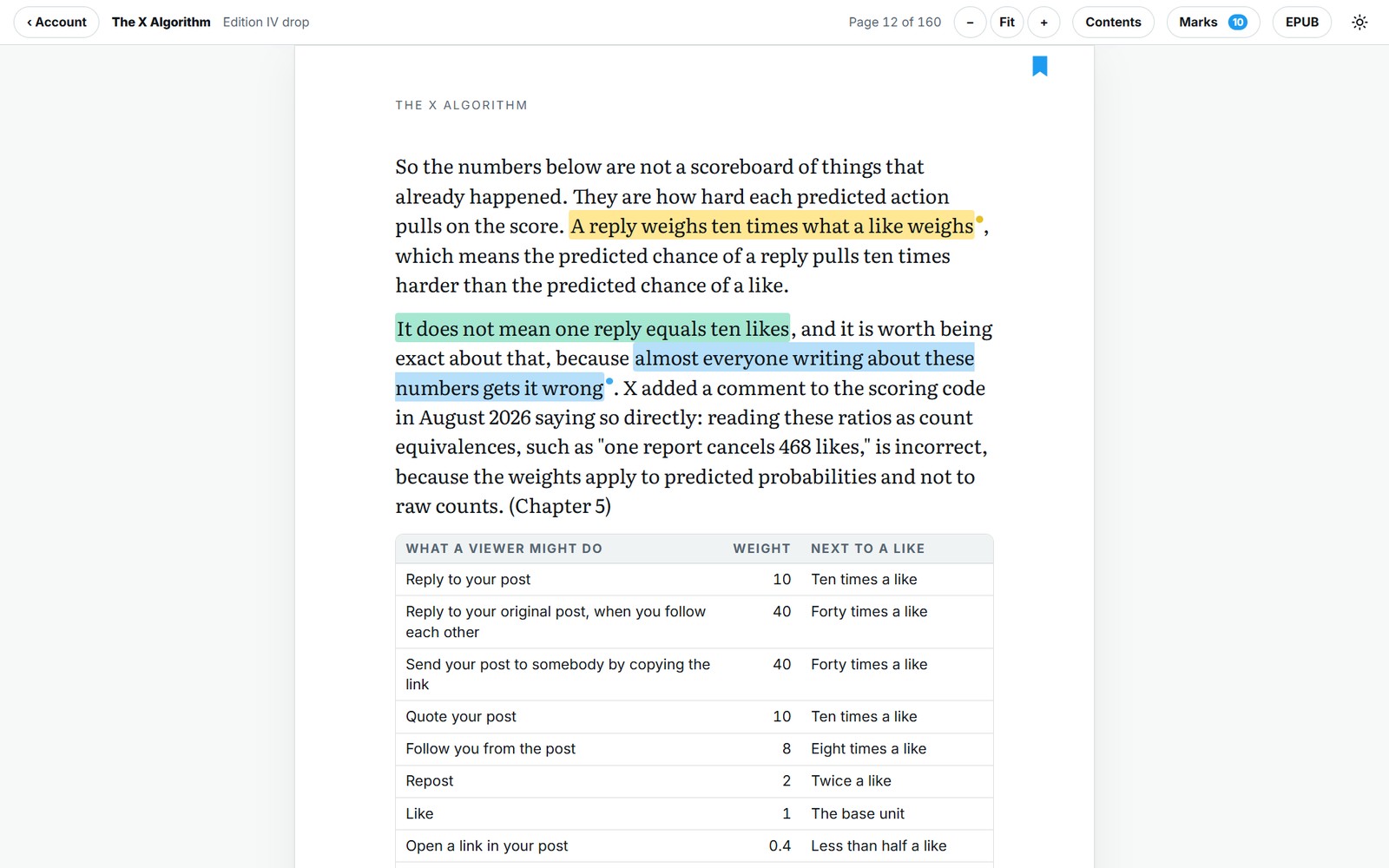
How do notes work?
Click a highlight, choose Note, and write. A small dot after the highlight shows there's a note, and clicking the dot opens it. Notes can also be added to bookmarks, from the Marks panel.
How do bookmarks work?
Every page has a ribbon at its top-right corner. Click it to bookmark the page, and click it again to take the bookmark off.
What is the Marks button?
The panel that lists every bookmark, highlight, and note you've made, with its chapter and page. Click one and the book jumps there.
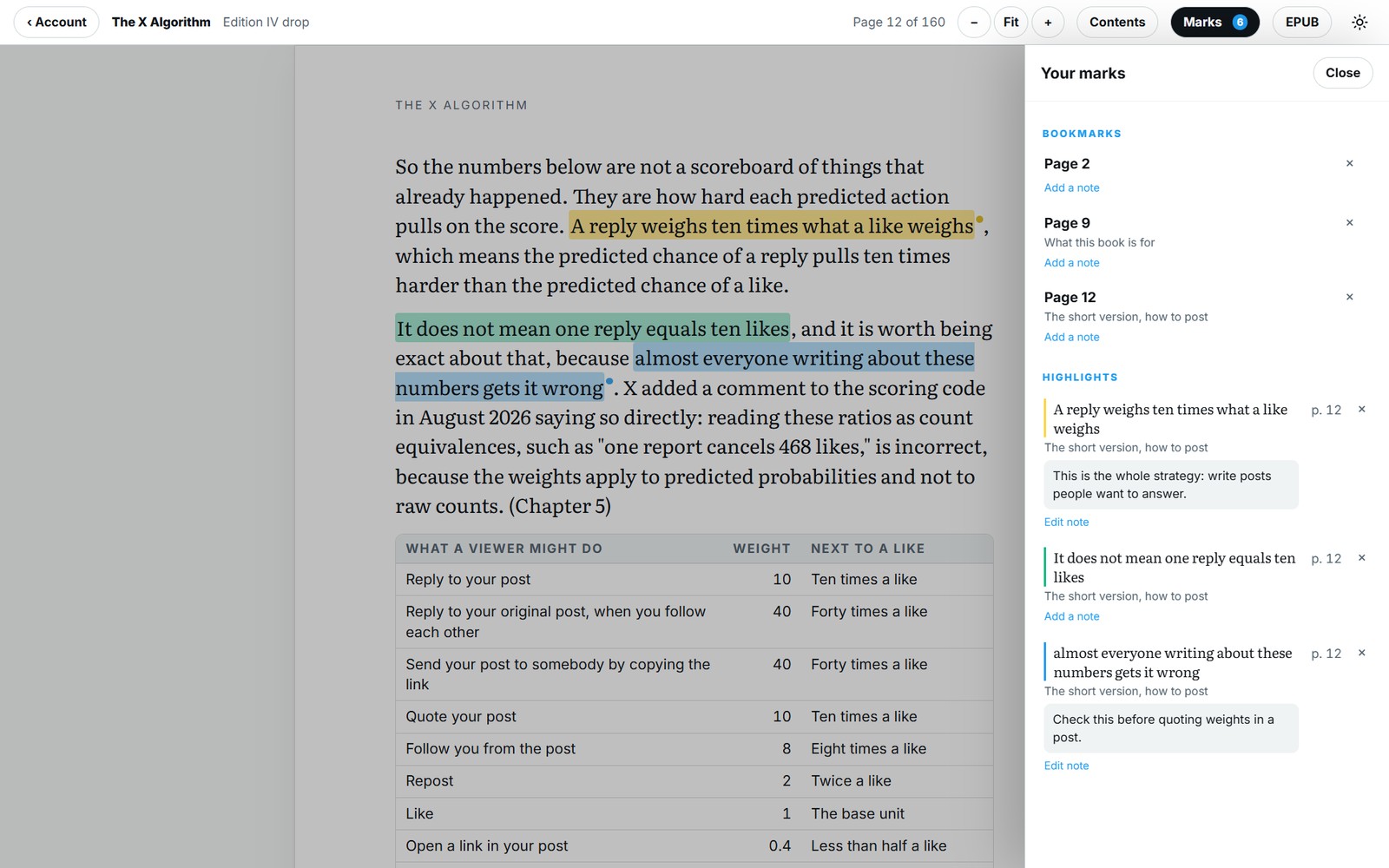
Do my highlights survive a drop?
Yes. They're tied to the words, not the page numbers, so when a new drop moves the pages they find their places again. If a passage was rewritten and can't be found, the highlight stays in the list marked as not found, so nothing disappears silently.
Can anyone else see my highlights and notes?
No. They're yours alone, never shared, never shown to anyone, and never used for anything.
Can I read in dark mode?
Yes. The sun and moon in the top bar switch the site and the book together.
Can I make the text bigger?
Yes. The minus, Fit, and plus buttons zoom the page. Fit fills the window.
Can I read on my phone?
Yes. The reader works in your phone's browser with the same highlights, notes and bookmarks, and keeps your place across devices.

Can I try the reader before buying?
Yes. The sample opens the same reader with the front of the book, all of Chapter 1, and the start of Chapter 2, and the highlights, notes, and bookmarks all work in it. Whatever you mark in the sample stays in your browser and is cleared when you buy.
What is the post lab?
A set of tools in your account for practicing what the book teaches: a good post against a bad post, five drills, a reply thread played out, a checker for your own draft, a day planner, a profile check, a monthly follow-back pass, and this month's examples. Everything in it is built from the book and updated with each drop. The lab may never say anything the book doesn't. It's included with a purchase here and isn't part of the Apple Books edition.
Your EPUB file
What the download is, and what it carries (purchases here).
What file do I get?
An EPUB, the standard ebook format, made for you. It opens in Apple Books, Google Play Books, Kobo, Calibre, Thorium, and any reader app, and it can be sent to a Kindle.
How do I put it on a Kindle?
Download the EPUB, then go to amazon.com/sendtokindle and drop the file in, or email it to your Kindle address. It shows up on the Kindle within a few minutes.
Why is my name in the file?
Every file is made for one reader.
The X Algorithm
Copyright © 2026 Bill G. Wolcott. All rights reserved.
Your Name you@example.com
- Your name and email appear on the copyright page.
- A copy identifier is carried in the text.
- It leads back to the account the file came from.
Keep it on as many of your own devices as you like. A copy that's passed to someone else leads back to the account it came from, and that account is closed.
Can I get the file again after a drop?
Yes, as often as you like. Under Downloads, download it again and the new file replaces the old one on your device.
I bought here. Can I get it in Apple Books?
Download your EPUB and open it on an iPhone, iPad, or Mac. It goes straight into the Books app and stays in your library. That's your copy, not the Apple Books edition, so drops arrive by downloading the new file rather than through Apple.
Account and sign-in
Signing in, changing your email, and devices (purchases here).
How do I sign in?
Choose Sign in and enter the email you bought with. A link comes by email and works once. Or set a password under Account and use that. Or use Continue with X or Google, if that's the same email address.
I didn't get the sign-in email.
Look in spam or promotions, and check that you entered the email you paid with. The link is good for twenty minutes, so ask for a fresh one if it has passed. If you bought on Apple Books, the book is in the Books app, not here. If you bought on Kindle, register your copy first.
Can I change my email?
Yes, under Account. A confirmation link goes to the new address, and the change is made when you open it. If you have a password, you enter it first.
I bought with the wrong email.
Write through the contact form from the address you can reach, with the name on the card and the date, and it's moved.
Can I read on more than one device?
Yes. Sign in on each, and the reader keeps your place on all of them. An account can stay signed in on up to six devices, and the oldest drops off when a seventh signs in.
How do I sign out everywhere?
Under Account, "Sign out everywhere else" signs every other device out and cancels unused sign-in links. Changing your password does the same.
Can I turn off the emails?
Drop and renewal emails, yes, under Account. Receipts and sign-in links still come, because they're how the book reaches you.
Apple Books
The same book in the Books app, and how it differs.
What is different about the Apple Books version?
It's the same book in the Books app on iPhone, iPad, and Mac, with the app's own highlights and notes, for $31.99. Apple delivers every drop for as long as the book is listed there, and Apple handles the purchase and any refund. It doesn't include an account here, the online reader, or the site's file.
I bought on Apple Books. Can I sign in here?
Not by itself: Apple never tells this site who bought, so there's no account to sign in to. The book, the drops, and Apple's highlights are all in the Books app.
Does buying on Apple help the person who recommended it?
No. If they're in Boost, our referral program, they earn only on a sale made here, and nothing on an Apple Books sale, because Apple never tells a publisher where a buyer came from. Buying here pays them $1 a sale at no cost to you, and your price is the same either way. Buying here also gets you the online reader, the highlights, notes and bookmarks, the post lab and the account that keeps all of it, none of which Apple Books includes.
Where do I get a refund on Apple Books?
Apple handles refunds, at reportaproblem.apple.com, under Apple's policy.
Kindle
The Kindle edition, and the free account that comes with it.
What is different about the Kindle version?
It's the same book in the Kindle app and on Kindle devices, with Kindle's own highlights and notes, for $6.99. It's the drop that's current on the day you buy. Amazon doesn't send later drops to people who already bought, so your Kindle copy stays that edition. Amazon handles the purchase and any refund.
I bought on Kindle. Can I have an account here?
Yes. Near the front of the Kindle book is a page called "Your free account" with a code. Enter it with your email on the Kindle registration page, and a sign-in link comes by email. The account includes the post lab and the results of the earnings tools, and you get an email when each new drop is out.
Can I get the monthly drops if I bought on Kindle?
Yes, here. Register your Kindle copy, and your account page offers twelve months of drops for $19.99: the online reader, your own EPUB, and every drop for twelve months. Nothing renews by itself.
Where do I get a refund on Kindle?
Amazon handles refunds for Kindle books, from your Amazon orders, under Amazon's policy.
Refunds and the license
What's refundable, and what the license allows.
Can I get a refund?
Here: the book is a digital file you can open at once, so the sale is final once you've opened it online or downloaded the file. If it won't open at all, write within 14 days and it's fixed or refunded in full. On Apple Books: Apple handles refunds, at reportaproblem.apple.com, under Apple's policy. On Kindle: Amazon handles refunds, under Amazon's policy.
What does the license allow?
- Reading the book yourself, online and on your own devices, as often as you like.
- Selling, renting, sharing, posting, or giving the book or its file to anyone.
- Sharing your sign-in.
- Copying the text into another product, course, or publication.
Is the book guaranteed to work?
No. It explains X's published code and rules. It doesn't guarantee any result, any number, or admission to any X program. X decides who is admitted and paid. The terms say this in full, and say it isn't legal, financial, or tax advice.
Privacy
What's collected and what isn't.
What do you collect?
Your email, your name if you give it, your purchases, your reading position, and your highlights and notes. Payment details stay with Stripe. Visitors are counted without cookies. Nothing is sold or shared for marketing, ever. The privacy page lists everything.
Can I delete my account?
Yes. Write from the address on the account and everything is deleted. That ends access to the book.
Does the site use cookies to track me?
Visitors are counted without cookies. The privacy page says what the site stores and why.
Still need help?
If the answer isn't here.
How do I ask a question that isn't answered here?
Use the contact form. It's answered by email, usually within a day. Write from the address on your account if the question is about your purchase.
Glossary
Every term the book uses, in plain words.
- Post
- What X used to call a tweet. Everything you publish on X is a post, including replies.
- Original post
- A post that isn't a reply to somebody else.
- Reply
- A post written under another post. Scored at 0.75 for viewers who don't follow you, and excluded from the program's impression count.
- Impression
- A post on a screen, once. The same person twice is two.
- Qualified impression
- An impression from a verified (Premium) viewer on the Home timeline, one per account per post, at least half on screen, on an original post. The only kind the rewards program counts.
- Verified
- A Premium subscriber. The checkmark.
- The X Subscription
- X's one plan for X, Grok, and Cursor, with the plans Free, Plus, Premium, Super, and Ultra. New customers start on it, and existing X Premium plans continue.
- In-network / out-of-network
- From an account the viewer follows, or from one they don't. Out-of-network posts are scored at 0.75.
- Popular-posts list
- A shared list of up to 500 recent posts from the most-followed active accounts, added to For You feeds in October 2026.
- Thunder
- X's in-memory store of the last 48 hours of posts. The in-network candidate source.
- Phoenix
- X's prediction model. It guesses the probability of each action for each viewer and post. Also the out-of-network retrieval model.
- SimClusters
- X's way of grouping accounts into about 145,000 communities by who engages with what, used to show posts to strangers in the same community.
- Weight
- The multiplier on a predicted probability. It isn't points.
- Author diversity decay
- Each post of yours after the first in the same scored pile is multiplied by (1 - floor) x decay^k + floor. At 0.5 and 0.25 that runs 1, 0.625, 0.4375, approaching 0.25 without reaching it.
- New-author lift
- One already-retrieved original post from an author with 50,000 followers or fewer, in its first two hours and first 200 impressions, raised to the level of the candidate at index 15 or 16. A place in the pile, not a place on the screen.
- Visibility filtering
- The separate system that decides whether a post can be shown at all, by a fixed list of rules over labels.
- Label
- A mark on a post or an account, applied by X's rules, that the visibility system reads.
- Recommendation-only rules
- The visibility rules that apply only when the viewer doesn't follow you. Most spam labels live here.
- Interstitial
- A warning the viewer taps through to see a post.
- Takedown
- A post or account withheld in a country by legal demand or local law, or removed for copyright.
- Scarecrow / Botmaker
- X's event rule engine and the language its rules are written in.
- Grox
- X's post classifiers, built on a large language model. The prompts are withheld.
- Agatha
- X's batch scorer of how other people respond to an account: blocks and reports per like.
- Behavior model
- X's model of an account's action sequence and timing, with eight bot scores.
- Credibility
- X's PageRank-style score from 0 to 100 over follows and this week's likes and reposts. Several enforcement rules skip an account with a high enough score. X doesn't publish the cutoff.
- Copypasta
- X's word for repeatedly posting identical or nearly identical posts. A content-spam violation.
- Under the Hood
- X's monthly report of any labels or takedowns on your posts or account. Zero is clean.
- Hand-off
- A tool sending a ready post to your phone with a button that opens X's post box. You press Post.
- Mutual follow
- You follow them and they follow you. Your original posts carry a higher reply weight in their feed.
- Card
- An image with a post's words on it.
- Drop
- The monthly release of the book, after the book is re-read against X's code, rules, and live data.
- Creator Subscriptions
- X's program that lets followers pay a creator a monthly fee for extra content and access. It needs 2,000 verified followers and 5,000,000 organic impressions in 3 months.
- Paid Partnership label
- The switch in the post box's Content Disclosure settings that X requires on any post promoting a product you were paid, gifted or paid a commission for.
- Amplify
- X's video monetization programs, Pre-roll (ads before your videos) and Sponsorships (a sponsor for your video content), set up in Media Studio.
- X Money
- X's financial services app. US creators are paid into it. Outside the US, creators connect Stripe instead.
- Shop Spotlight
- A carousel of up to 5 products on your X profile. A full X Shop holds up to 50, and customers check out on your own site.
- Restricted monetization
- X's phrase for content in a sensitive category, such as strong language or debatable social issues, that "may face restricted monetization."
Nothing matches .
Try a shorter word, or ask us and we'll answer by email, usually within a day.
Ask a questionWrite to us and it's answered by email, usually within a day.